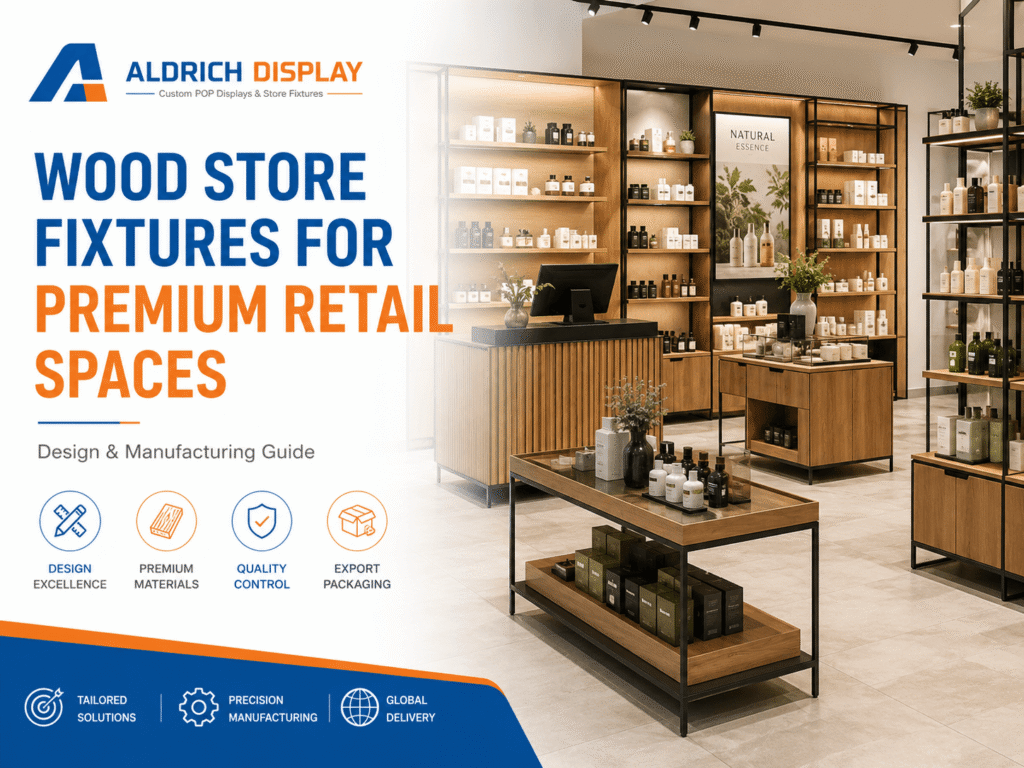
In premium retail environments, store fixtures do much more than hold products.
They help define the atmosphere of the store.
They influence how customers perceive the brand, how products are presented, and how the overall retail space feels.
This is why wood store fixtures are widely used in premium retail spaces.
Compared with basic metal shelving or standard retail racks, wood fixtures can create a warmer, more refined, and more customized appearance.
They are commonly used in:
- Fashion stores
- Cosmetics stores
- Lifestyle shops
- Boutique retail
- Jewelry stores
- Wine stores
- Beauty stores
- Premium supermarkets
- Brand showrooms
- Shop-in-shop areas
For brands that want to create a stronger retail identity, custom wood store fixtures can be an important part of the overall shopfitting strategy.
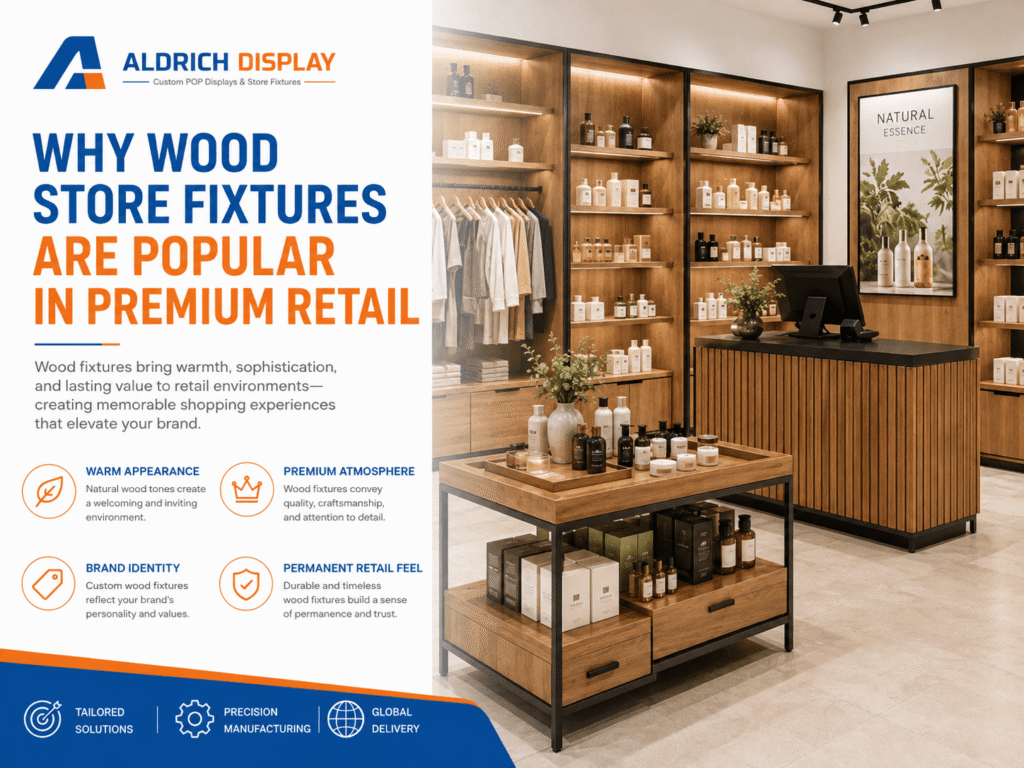
1. Why Wood Store Fixtures Are Popular in Premium Retail
The first reason is visual impact.
Wood naturally creates a warmer and more sophisticated feeling than many standard commercial materials.
Depending on the finish, wood fixtures can look:
- Minimal
- Natural
- Luxury
- Contemporary
- Industrial
- Scandinavian
- Traditional
- High-end
This flexibility makes wood suitable for many different brand styles.
A premium skincare brand may use light wood and clean white surfaces.
A wine store may prefer darker wood tones.
A fashion retailer may combine wood shelves with black powder-coated metal frames.
The same basic material can support very different retail environments.
Wood also makes fixtures feel more permanent
Temporary promotional displays are often designed to attract attention quickly.
Premium store fixtures usually need a different feeling.
They should look like part of the architecture and store interior.
Wood helps create this sense of permanence.
That is why it is often used for:
- Wall fixtures
- Display cabinets
- Retail tables
- Shelving units
- Checkout counters
- Product islands
- Branded feature displays
2. Common Buyer Pain Points with Wood Store Fixtures
Wood fixtures can look simple in a rendering, but real manufacturing involves many details.
Several common issues can affect the final result.
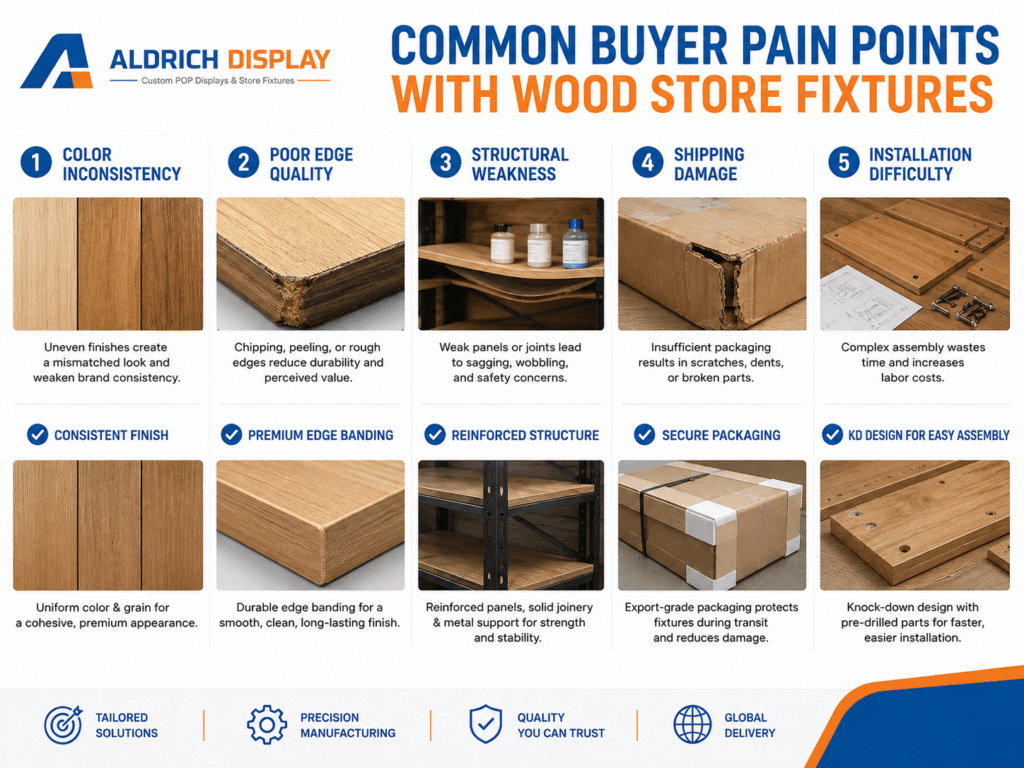
Color inconsistency
Wood appearance can vary depending on the material, laminate, veneer, paint, or surface treatment.
For multi-store rollout projects, buyers usually want consistent color across all stores.
This means the manufacturer needs to control:
- Board selection
- Veneer direction
- Laminate batch
- Paint color
- Surface finish
- Sample approval
Edge quality
A premium fixture can quickly look cheap if the edges are poorly finished.
Edge banding, corner finishing, joints, and panel alignment all matter.
Customers often view wood fixtures from a close distance, so small finishing issues become visible.
Structural weakness
Wood panels alone may not always provide enough support for heavier products.
This is why many fixtures use:
Wood + metal frame
The metal structure provides strength while wood provides the premium appearance.
Damage during shipping
Wood fixtures can suffer from:
- Scratched surfaces
- Chipped corners
- Crushed edges
- Moisture damage
- Panel deformation
For overseas projects, packaging design is especially important.
Installation difficulty
Large wood fixtures can become difficult to ship and install if the structure is not planned correctly.
This is why KD or modular construction is often considered during engineering.
3. Common Types of Wood Store Fixtures
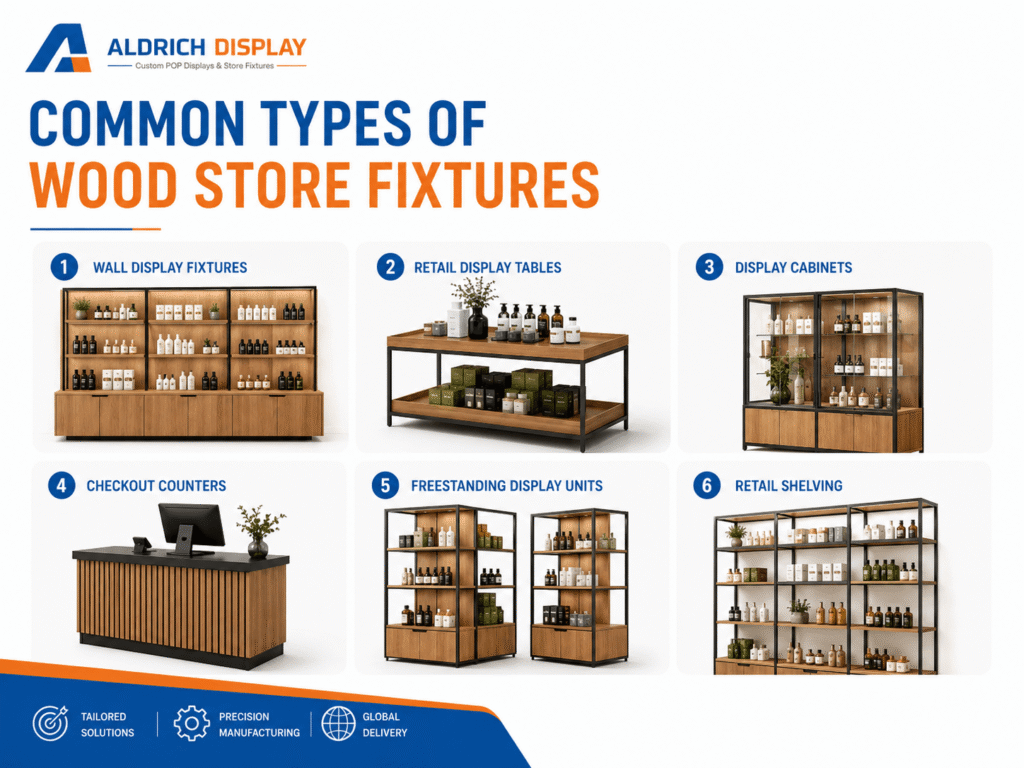
Wood can be used in many different retail fixture applications.
Wall Display Fixtures
Wall fixtures are one of the most common applications.
They can include:
- Wood back panels
- Adjustable shelves
- Hooks
- Cabinets
- Branding panels
- Integrated metal supports
Wall fixtures help use vertical store space while creating a clean and organized presentation.
Retail Display Tables
Display tables are popular in fashion, footwear, cosmetics, and lifestyle retail.
They can be used for:
- Folded clothing
- Shoes
- Accessories
- Cosmetics
- Featured products
Wood display tables often create a more premium look than standard metal tables.
Display Cabinets
Wood display cabinets can include:
- Shelves
- Drawers
- Glass doors
- Acrylic sections
- Lighting
- Locks
- Logo panels
They are often used for high-value or carefully presented products.
Checkout Counters
Checkout counters are important functional fixtures.
They may include:
- Countertop areas
- Storage
- Drawers
- Cable management
- Branding panels
- Customer-facing displays
Because the checkout counter is usually highly visible, its finish quality is very important.
Freestanding Display Units
Freestanding wood fixtures are useful for:
- Product launches
- Feature zones
- Shop-in-shop areas
- Category displays
- Premium promotional spaces
They can be combined with signage, lighting, acrylic holders, or metal structures.
Retail Shelving
Wood shelves are commonly used when brands want a softer or more premium appearance than standard metal shelving.
They can be fixed or adjustable depending on the fixture design.
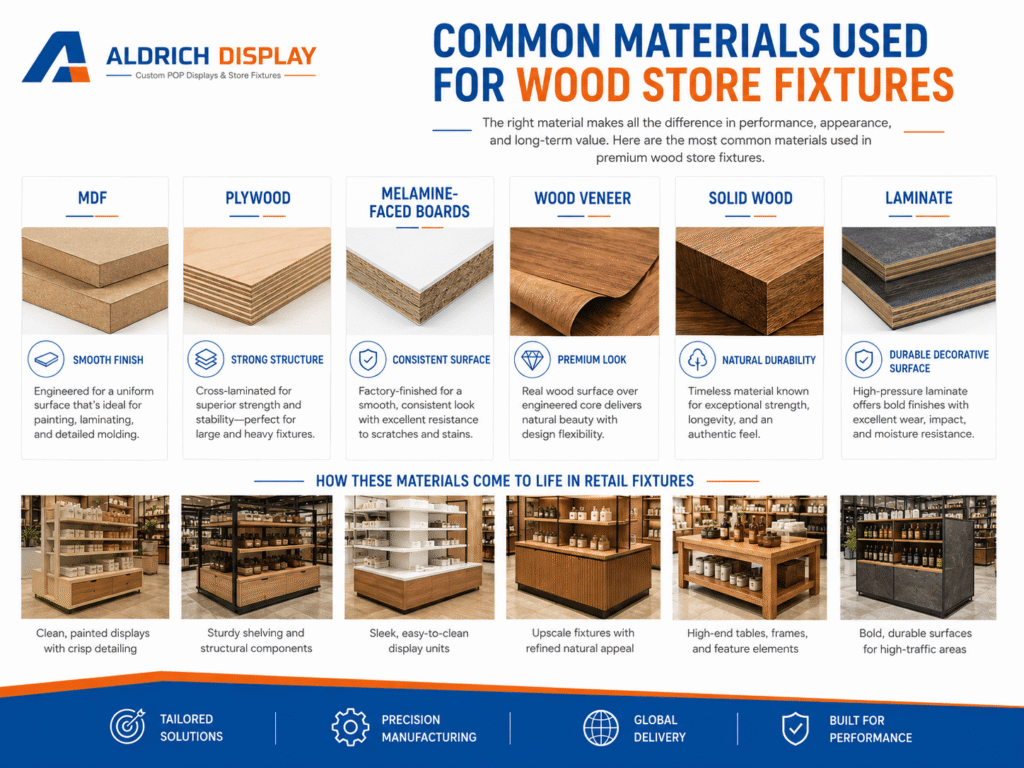
4. Common Materials Used for Wood Store Fixtures
“Wood fixture” does not always mean solid wood.
Different materials are used depending on cost, structure, finish, and project requirements.
MDF
MDF is widely used in custom retail fixtures.
Advantages include:
- Smooth surface
- Easy machining
- Good paint finish
- Consistent panel quality
- Suitable for custom shapes
MDF is commonly used for cabinets, display tables, shelves, and decorative panels.
Plywood
Plywood is stronger than standard MDF in many applications.
It is suitable for:
- Structural panels
- Cabinets
- Shelves
- Fixture bodies
- Heavy-duty retail furniture
It is often selected when strength is more important.
Melamine-Faced Boards
Melamine boards are practical for retail applications because they are available in many colors and wood patterns.
They can provide a consistent finish and are often more cost-efficient than natural veneer.
Wood Veneer
Natural wood veneer can create a more premium appearance.
It provides the look and texture of real wood while using a panel substrate underneath.
Veneer is commonly used in high-end retail environments.
Solid Wood
Solid wood can be used for premium decorative parts, frames, trims, or feature furniture.
However, it is usually more expensive and can require more careful moisture and deformation control.
Laminate
High-pressure laminate and decorative laminates are widely used when durability and consistent surface appearance are important.
They can simulate:
- Wood grain
- Stone
- Concrete
- Solid colors
- Textured surfaces
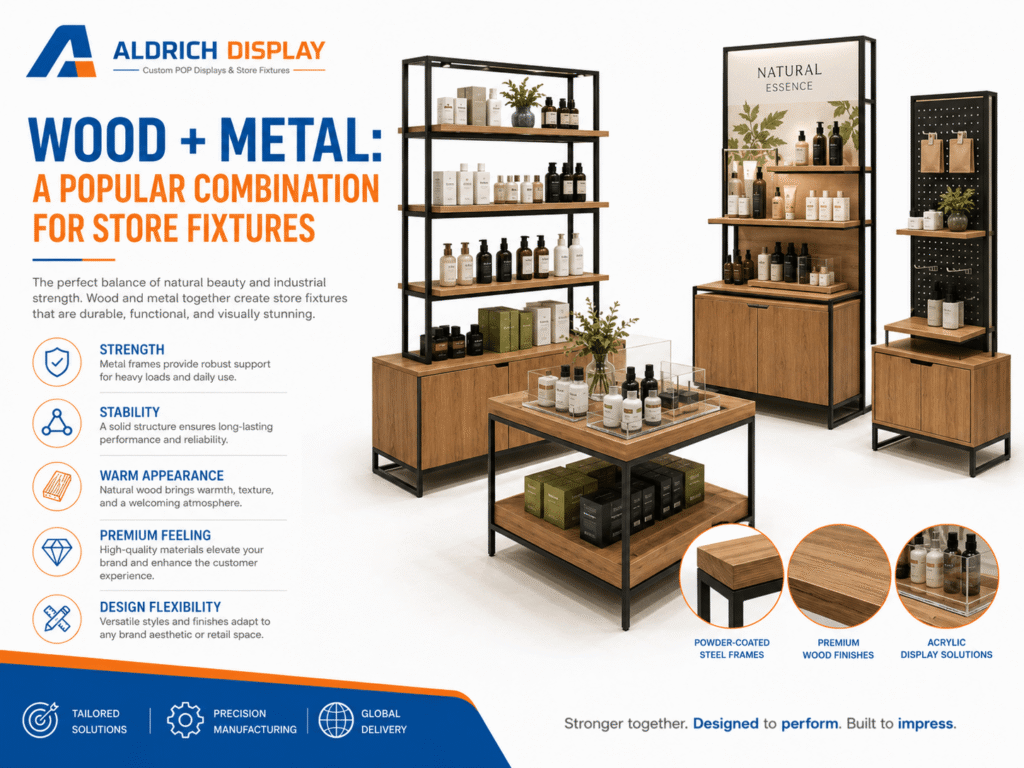
5. Wood + Metal: A Popular Combination for Store Fixtures
Many premium store fixtures do not rely on wood alone.
Instead, they combine wood with metal.
This gives buyers the advantages of both materials.
Metal provides:
- Strength
- Stability
- Thin structural profiles
- Long-term durability
Wood provides:
- Warm appearance
- Premium feeling
- Branding flexibility
- Decorative value
For example, a retail fixture may use:
- Powder-coated steel frame
- MDF or plywood shelves
- Wood veneer panels
- Acrylic product holders
- Printed branding header
This type of mixed-material fixture is common in modern retail environments.
It also gives designers more flexibility.
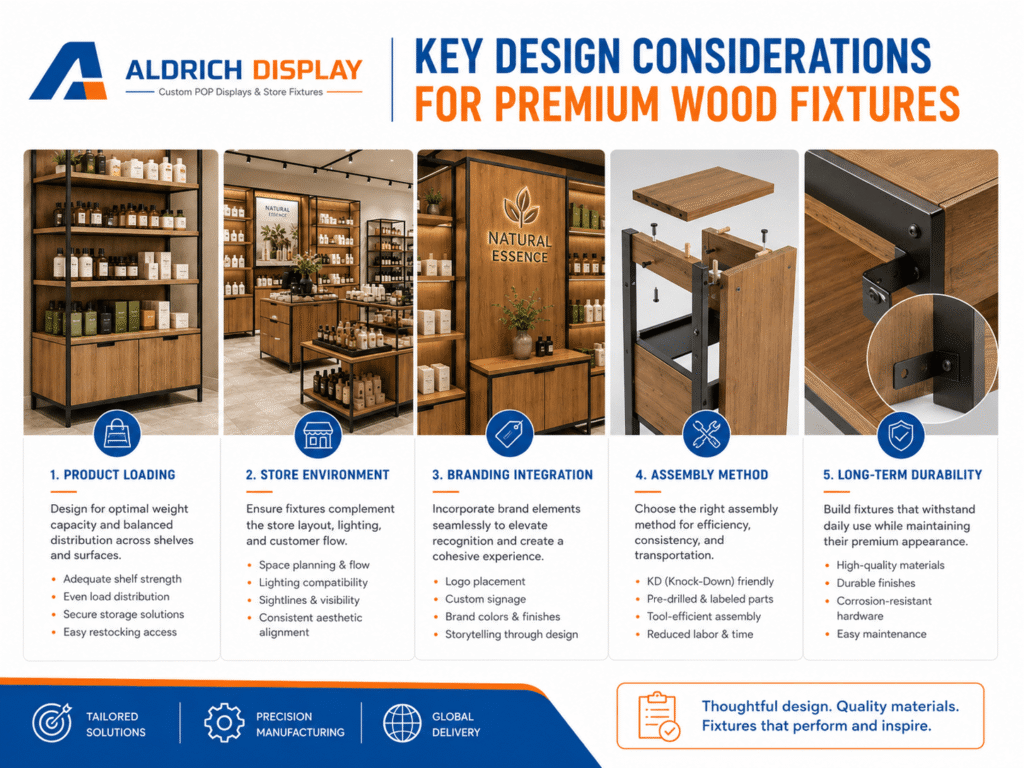
6. Key Design Considerations for Premium Wood Fixtures
Good wood store fixture design needs to balance appearance and function.
Product loading
The manufacturer needs to understand:
- Product size
- Product weight
- Shelf quantity
- Total loading requirement
This helps determine panel thickness and structural support.
Store environment
A fixture designed for a boutique clothing store may be very different from one designed for a supermarket.
The store layout affects:
- Size
- Shape
- Visibility
- Customer access
- Fixture height
Branding
Wood fixtures can incorporate branding through:
- Printed graphics
- CNC-cut logos
- Metal logos
- Acrylic signs
- Engraving
- Color matching
Branding should be planned early so that it integrates naturally with the fixture.
Assembly method
For international projects, the fixture may need to be designed for KD packing.
Good engineering can reduce shipping volume without making assembly too difficult.
Long-term durability
Premium retail fixtures may be used for years.
This means the manufacturer should consider:
- Surface resistance
- Edge protection
- Shelf strength
- Hardware quality
- Repeated use
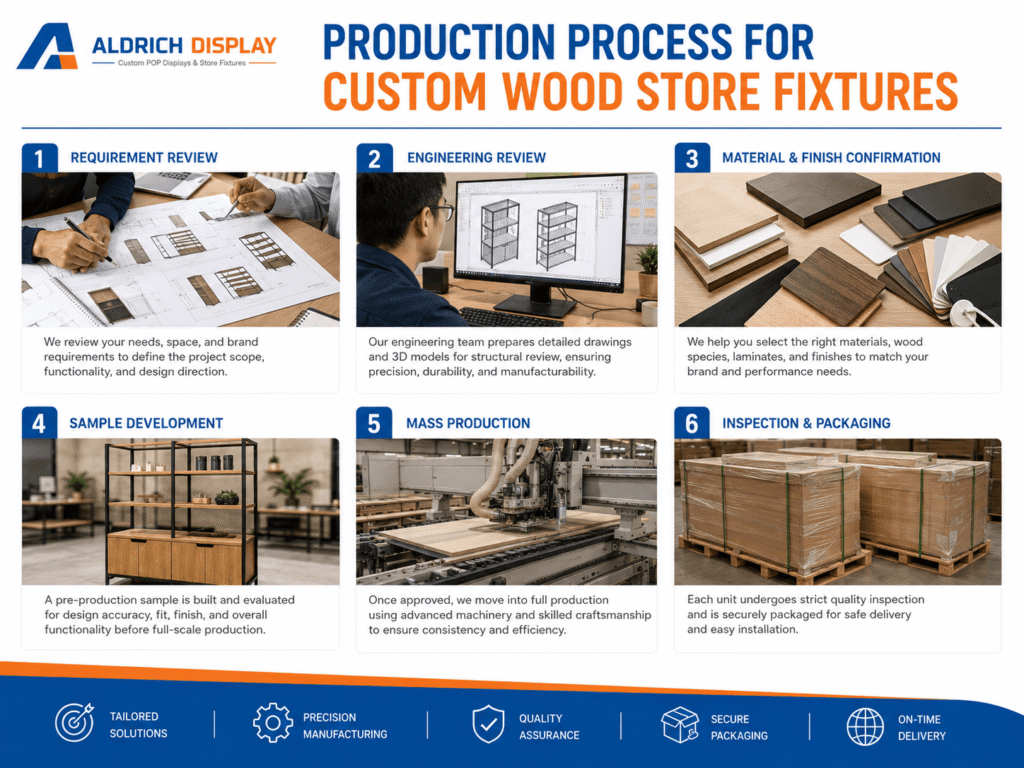
7. Production Process for Custom Wood Store Fixtures
A professional wood fixture project should follow a structured process.
Step 1: Requirement Review
The manufacturer reviews:
- Drawings
- Dimensions
- Material requirements
- Quantity
- Color
- Finish
- Branding
- Store environment
Step 2: Engineering Review
The structure is checked for:
- Strength
- Panel thickness
- Hardware
- Connections
- Assembly
- Production feasibility
- Packaging
Step 3: Material and Finish Confirmation
For premium projects, finish approval is important.
The buyer may confirm:
- Wood grain
- Laminate
- Veneer
- Paint color
- Surface texture
- Metal finish
Step 4: Sample Development
A sample or prototype allows the buyer to review the fixture before mass production.
Important points include:
- Appearance
- Dimensions
- Structure
- Color
- Assembly
- Branding
- Product fit
Step 5: Mass Production
Production may include:
- Panel cutting
- CNC machining
- Drilling
- Edge banding
- Lamination
- Painting
- Metal fabrication
- Assembly
- Branding installation
Step 6: Inspection and Packaging
Before shipment, fixtures should be inspected and packed according to the approved standard.
8. Quality Control for Wood Store Fixtures
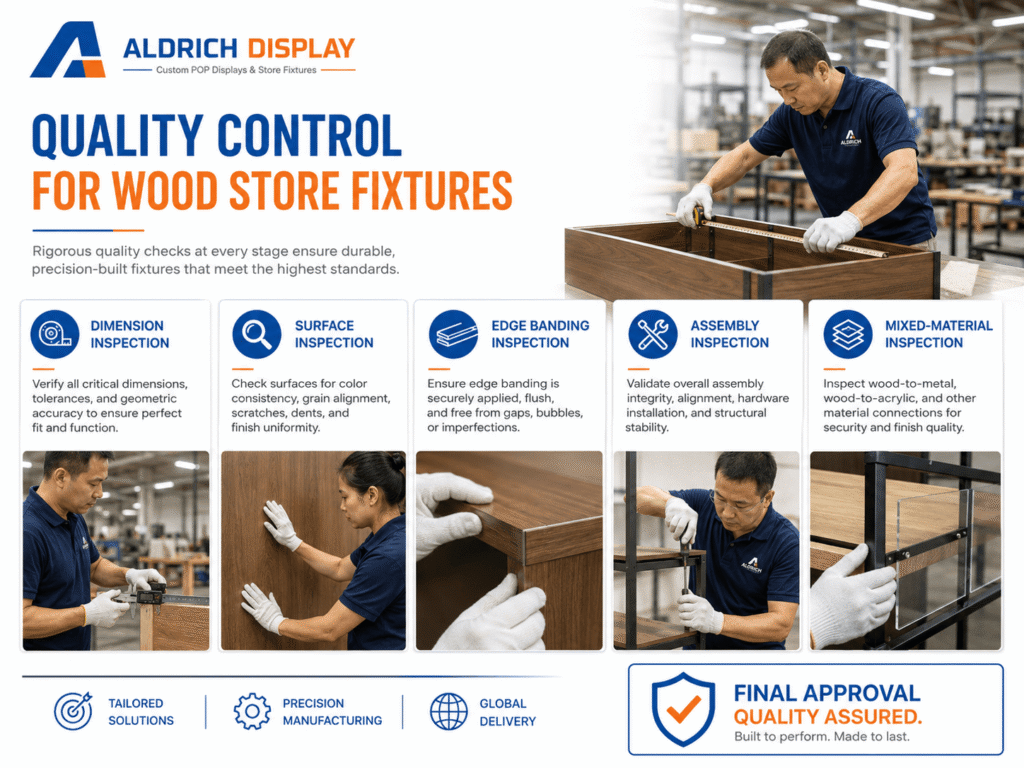
Premium retail fixtures require good quality control because customers see the products at close range.
Dimension Inspection
The factory should confirm:
- Width
- Height
- Depth
- Shelf spacing
- Hole locations
- Connection points
Surface Inspection
Wood surfaces should be checked for:
- Scratches
- Color differences
- Glue marks
- Uneven finish
- Damage
- Edge defects
Edge Banding Inspection
Edges should be:
- Clean
- Straight
- Smooth
- Properly bonded
Poor edge banding can seriously reduce the visual quality of a fixture.
Assembly Inspection
For KD fixtures, trial assembly helps confirm that:
- Parts fit correctly
- Hardware is complete
- Holes align
- Installation is practical
Mixed-Material Inspection
When wood is combined with metal, acrylic, or glass, the factory also needs to check fit and tolerance between different parts.
9. Packaging Wood Fixtures for International Shipping
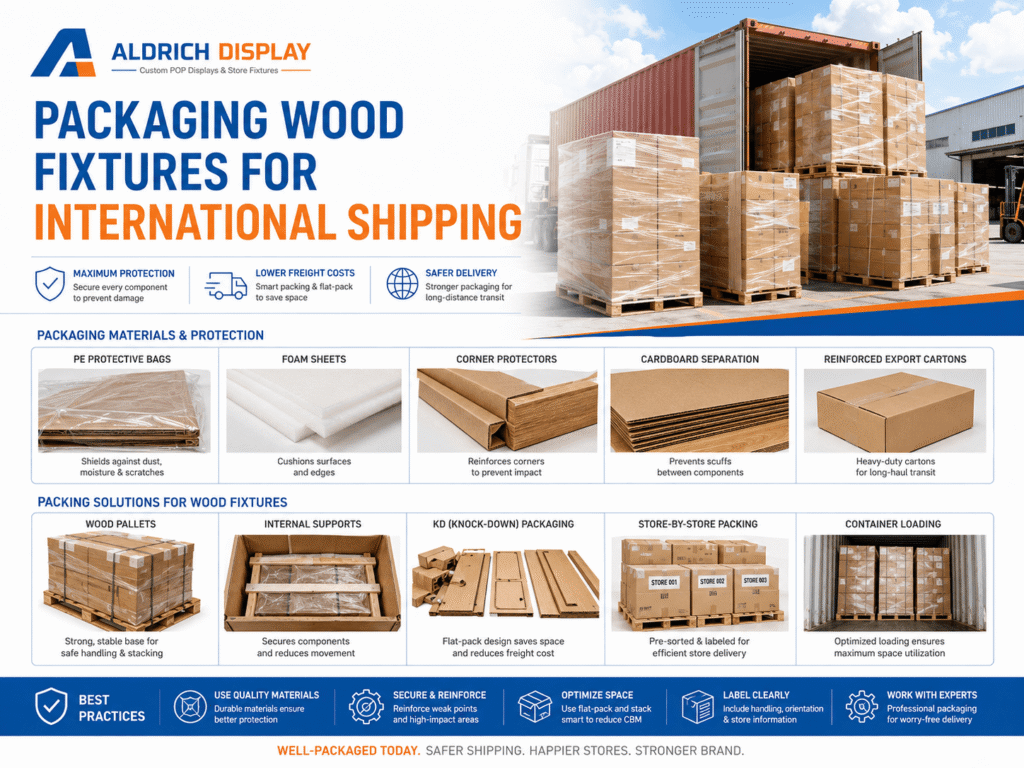
Export packaging is especially important for wood fixtures.
Unlike simple metal racks, wood panels can be vulnerable to impact around corners and edges.
Good packaging may include:
- PE or protective bags
- Foam sheets
- Corner protectors
- Cardboard separation
- Reinforced export cartons
- Wood pallets
- Internal supports
The packaging should protect both the structure and the decorative surface.
KD Packaging
KD packaging is often useful for larger wood fixtures.
It can help:
- Reduce carton volume
- Improve container loading
- Reduce freight cost
- Simplify warehouse storage
However, the manufacturer should test the assembly before shipment.
Store-by-Store Packing
For multi-store rollout projects, wood fixtures can also be packed according to each store’s quantity.
This helps reduce sorting work after arrival and makes local distribution easier.
10. Case Example: Wood and Metal Fixtures for a Premium Retail Rollout
A retail brand planned a new store fixture program for multiple locations.
The design included:
- Powder-coated metal frames
- Wood shelves
- Decorative side panels
- Acrylic product holders
- Branded header panels
The customer wanted a premium appearance while keeping the fixtures practical for international shipping.
During engineering review, several adjustments were made.
The metal frame was optimized for better stability.
Some wood panels were changed to a more suitable board structure to improve durability.
The fixture was redesigned in KD form to reduce shipping volume.
Protective packaging was added around exposed corners and decorative surfaces.
The acrylic components were separated from the wood panels to prevent scratching during shipment.
After sample approval, the fixtures moved into mass production.
Before shipment, the factory completed:
- Dimension inspection
- Color checking
- Surface inspection
- Trial assembly
- Hardware checking
- Packaging inspection
The final result combined the warm appearance of wood with the structural strength of metal.
This is a common example of how mixed-material wood store fixtures can support premium retail environments.
11. Wood Store Fixtures vs Metal Store Fixtures
Both materials have advantages.
Wood fixtures are often better when:
- Premium appearance matters
- The store needs a warm atmosphere
- Branding is important
- The fixture is part of interior design
- Decorative surfaces are required
Metal fixtures are often better when:
- Heavy loading is required
- Long-term strength is the priority
- The structure needs to be thinner
- Industrial or minimalist styling is preferred
Many projects use both materials together.
The right decision depends on product type, retail environment, budget, and brand positioning.
12. FAQ About Wood Store Fixtures
What materials are commonly used for wood store fixtures?
Common options include MDF, plywood, melamine-faced boards, laminate, wood veneer, and solid wood.
Are wood store fixtures suitable for heavy products?
Yes, but the structure needs to be engineered correctly. For heavier products, wood panels are often combined with a metal support frame.
Can wood store fixtures be customized?
Yes. Custom wood fixtures can be produced according to drawings, dimensions, materials, colors, finishes, branding requirements, and store layouts.
Can wood fixtures be shipped flat packed?
Yes. Many wood fixtures can be designed in KD or flat-pack form to reduce shipping volume and freight cost.
How can wood fixtures be protected during international shipping?
Protection may include reinforced cartons, foam, corner protection, surface wrapping, internal separators, and pallets.
What finishes are available for wood retail fixtures?
Common options include laminate, melamine, paint, veneer, wood grain finishes, and other decorative surfaces.
Can wood fixtures be combined with metal or acrylic?
Yes. Metal, wood, acrylic, glass, wire, and printed graphics are commonly combined in custom retail fixtures.
Are wood fixtures suitable for multi-store retail rollouts?
Yes. Once the sample, material, color, and production standard are approved, the same fixture can be produced consistently for larger rollout programs.
Final Thoughts
Wood store fixtures remain one of the most effective ways to create a premium retail environment.
They provide warmth, flexibility, and strong branding possibilities while supporting many different product categories.
The best wood fixture projects combine:
Good design + Correct materials + Structural engineering + Consistent manufacturing + Quality control + Export-ready packaging
For international retail projects, these details are especially important.
A fixture should not only look good when it leaves the factory.
It should also arrive safely, install smoothly, and perform well in the store.