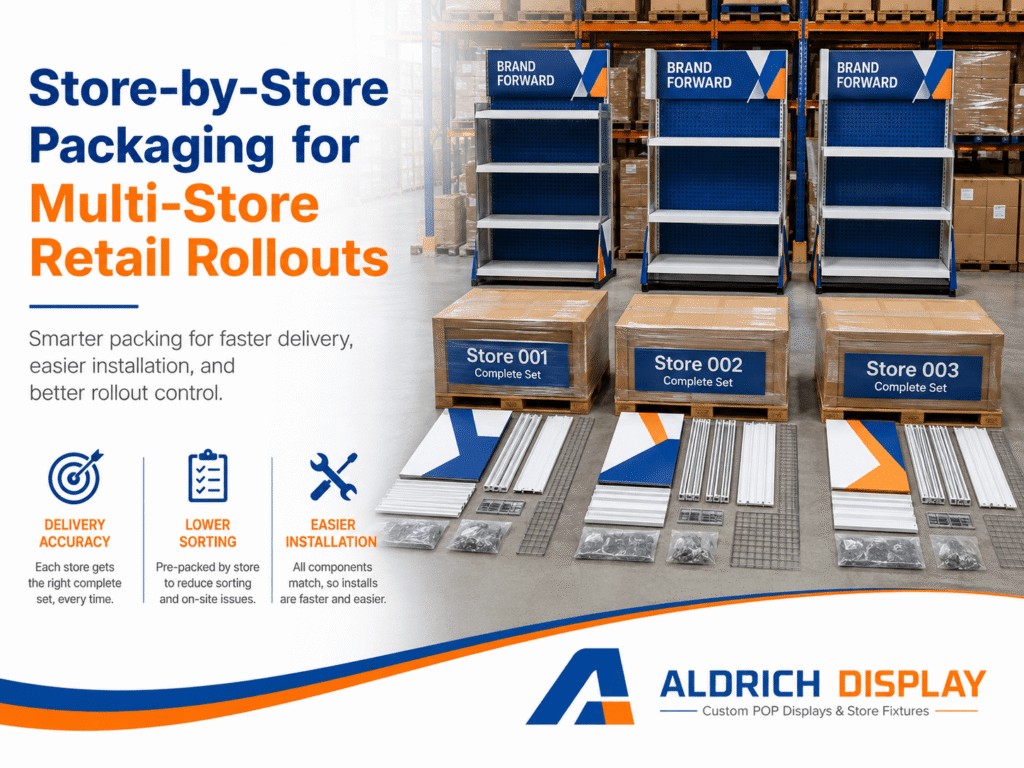
For multi-store retail rollout projects, packaging is not only about protecting the product during shipment.
It is also about making the whole delivery and installation process easier.
When a project involves dozens or even hundreds of stores, each store may require different quantities of POP displays, store fixtures, accessories, spare parts, or installation components.
If all products are packed in bulk, the overseas warehouse still needs to spend a lot of time sorting, checking, repacking, labeling, and arranging delivery to each store.
That may look like a small issue at the beginning.
But for large retail rollouts, poor packaging planning can create serious problems after the goods arrive.
It can delay store installation, increase warehouse labor cost, create missing parts risk, and cause unnecessary communication between the buyer, warehouse, installation team, and supplier.
That is why store-by-store packaging is becoming an important part of professional custom display manufacturing and retail fixture export projects.
Why Bulk Packing Creates Problems for Retail Rollouts
Bulk packing may work for simple orders.
But for multi-store retail projects, it often creates extra work after shipment.
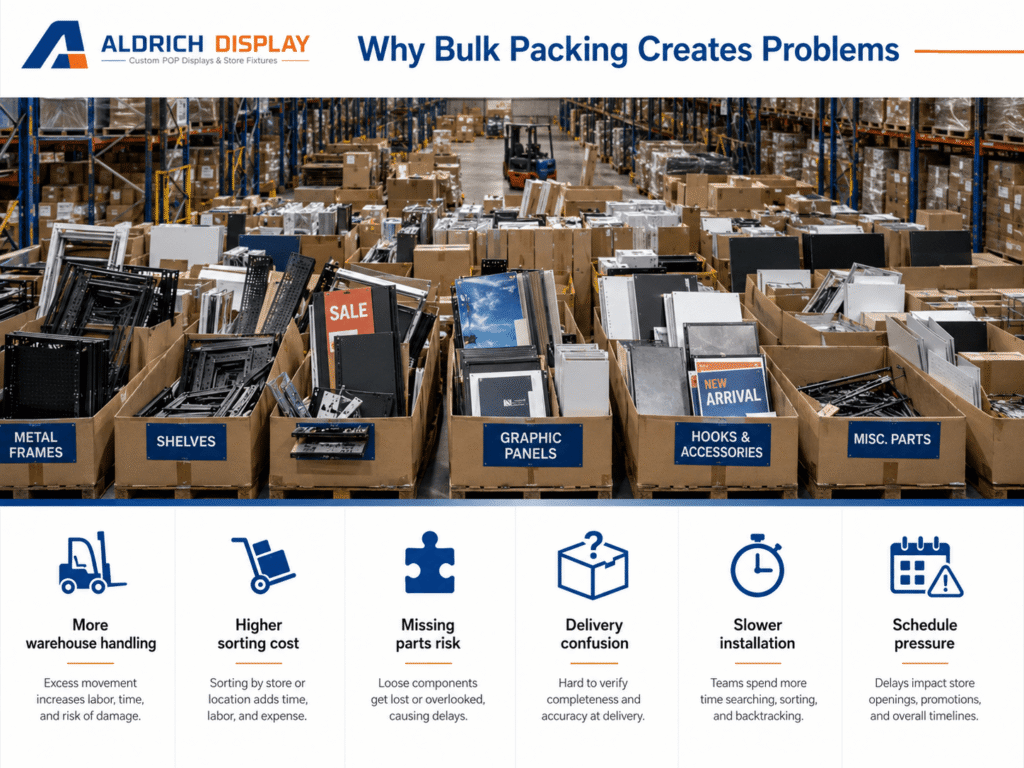
For example, one container may include display racks, shelves, hooks, brackets, screws, graphic panels, sign holders, and installation accessories for many different store locations.
If everything is packed together by product type, the warehouse must sort everything again after arrival.
This can create several common problems:
- More warehouse handling
- Higher sorting and labor cost
- Higher risk of missing parts
- Confusion during local delivery
- Slower installation at each store
- More back-and-forth communication
- More pressure on the rollout schedule
For retail projects with strict opening dates or promotional launch timelines, these problems can affect the whole rollout plan.
Good packaging should not only protect the fixture.
It should also support the customer’s distribution and installation workflow.
What Is Store-by-Store Packaging?
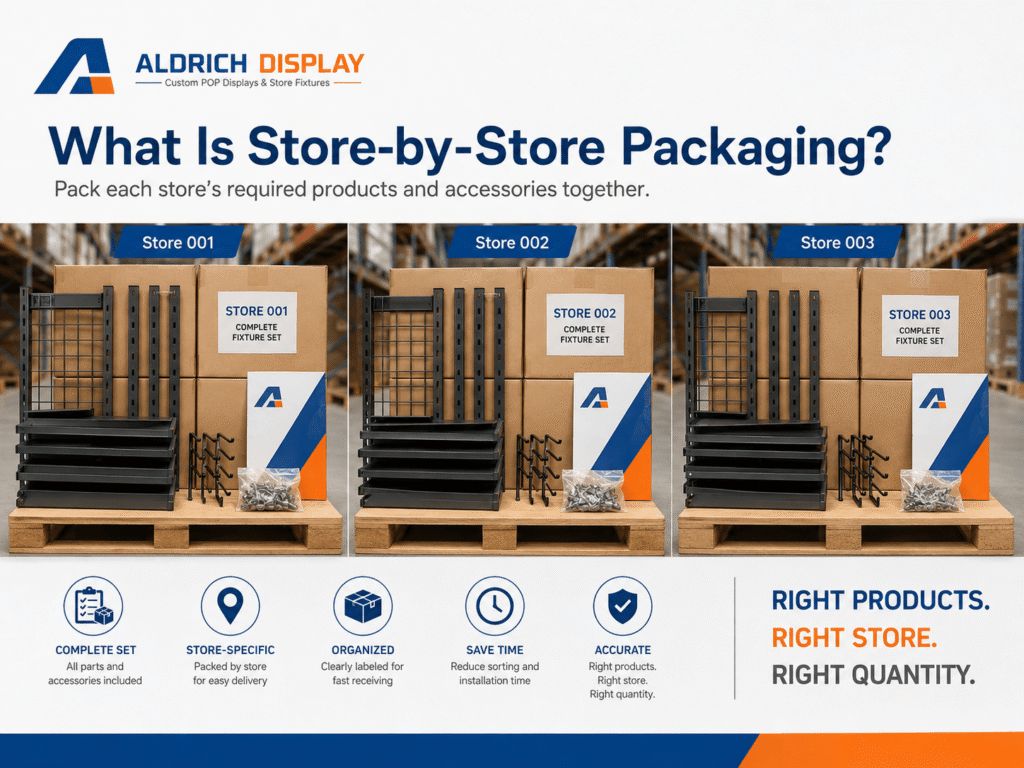
Store-by-store packaging means the products are packed according to each individual store’s requirement.
Instead of packing all display racks together, all shelves together, and all accessories together, the factory organizes the goods based on the customer’s store list.
For example:
Store 001 may require 10 display racks, 20 hooks, 5 graphic panels, and 1 hardware kit.
Store 002 may require 8 display racks, 16 hooks, 4 graphic panels, and a different accessory set.
Store 003 may need a special configuration because the store layout is different.
In this case, each store’s products can be packed, labeled, and palletized separately.
The goal is simple:
The right products should go to the right store, with the right parts, in the right quantity.
This helps the overseas warehouse arrange direct delivery to different store locations more efficiently.
What Can Be Included in Store-by-Store Packing?
For custom POP display and store fixture projects, store-by-store packing can include many different items.
Common examples include:
- Metal display racks
- Wire display racks
- Wood shelves
- Acrylic holders
- Graphic panels
- Header signs
- Hooks and brackets
- Screws and hardware
- Installation tools or accessories
- Spare parts
- Assembly instructions
- Store-specific labels
The key point is not only packing the main fixture.
The accessories and installation components must also be matched correctly.
A display rack without the correct hooks, screws, or graphic panels can delay the installation even if the main product arrives safely.
How Store-by-Store Packing Works
A professional retail display manufacturer should plan the packaging process before shipment, not after production is finished.
The process usually includes several steps.
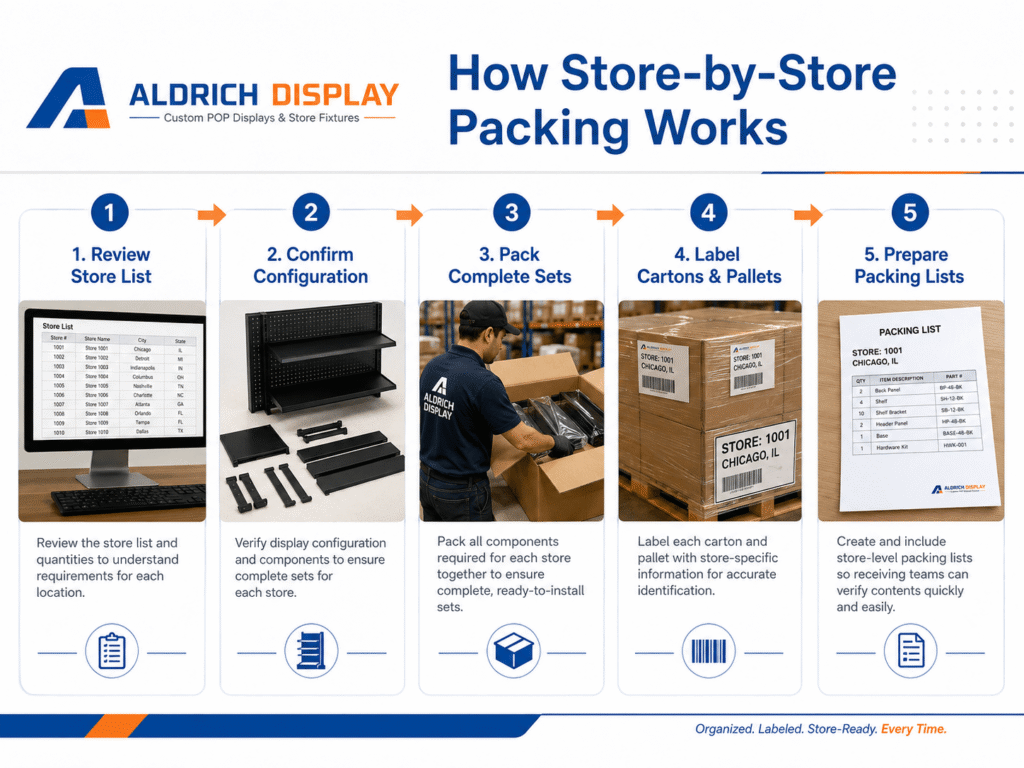
1. Review the Store List
The customer provides a store list with quantity requirements for each location.
This may include:
- Store number
- Store name
- Delivery location
- Product quantity
- Fixture configuration
- Accessory requirements
- Special packing notes
This information becomes the foundation of the packing plan.
2. Confirm Product Configuration for Each Store
Not every store has the same requirement.
Some stores may need more display racks.
Some may need fewer accessories.
Some may require special components because of different store layouts.
Before packing, the factory should confirm the product configuration for each store clearly.
3. Pack Complete Sets by Store
Based on the store list, the factory can pack the correct products and accessories together.
For example:
Store 001:
- Main display rack set
- Matching shelves
- Required hooks
- Graphic panels
- Hardware kit
- Installation reference
Store 002:
- Different display quantity
- Different accessory quantity
- Store-specific label
- Separate pallet or carton group
This makes the shipment easier to receive, sort, and deliver.
4. Label Cartons and Pallets Clearly
Clear labeling is one of the most important parts of store-by-store packaging.
Each carton or pallet can be marked with:
- Store number
- Product code
- Product name
- Quantity
- Part name
- Carton number
- Pallet number
- Installation reference
- Shipping mark
- Barcode if required
This helps warehouse teams quickly identify where each carton or pallet should go.
5. Prepare Packing Lists by Store
For larger projects, a store-level packing list is very useful.
It allows the customer, warehouse, and installation team to check what should be included for each store.
This reduces confusion and makes receiving inspection much easier.
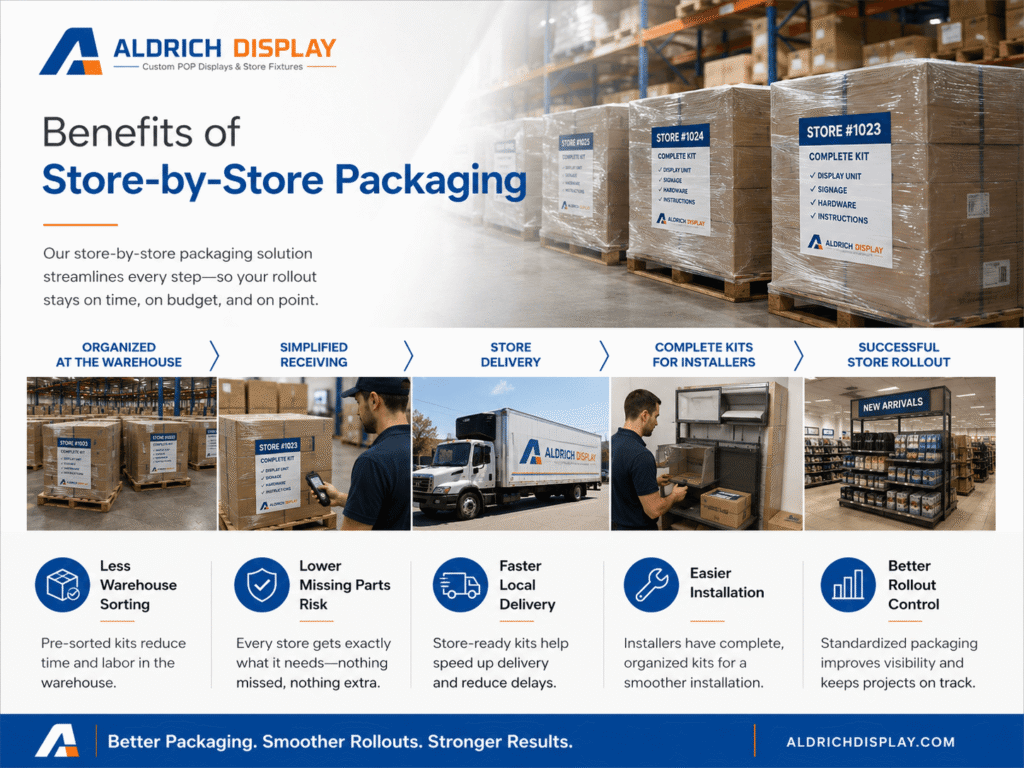
Benefits of Store-by-Store Packaging
Store-by-store packaging creates value after the goods arrive overseas.
It helps the customer save time, reduce risk, and control the rollout more effectively.
Less Warehouse Sorting
When cartons and pallets are already organized by store, the warehouse does not need to open everything and sort all parts again.
This reduces handling time and labor cost.
Lower Missing Parts Risk
Accessories, hardware, and installation parts can be packed together with the related fixture.
This reduces the risk that one store receives the main fixture but misses important components.
Faster Local Delivery
After customs clearance and warehouse receiving, the customer can arrange courier, truck delivery, or local distribution directly to different stores.
This makes the whole delivery process faster.
Easier Installation
Installation teams can quickly identify the parts they need.
Clear carton labels, store numbers, and hardware organization help reduce installation delays.
Better Rollout Control
For chain store projects, project managers need to know which store has received which products.
Store-by-store packing helps improve visibility and control.
It makes the rollout process easier to track.
Why Packaging Should Be Planned Before Production Ends
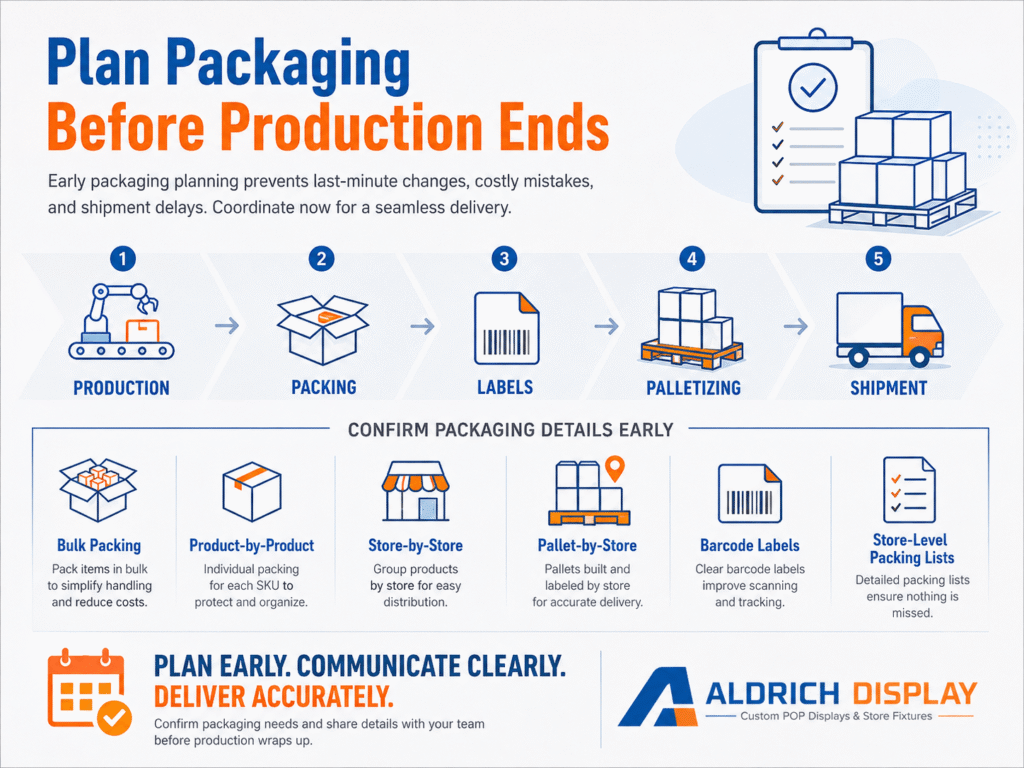
Many buyers only think about packaging after production is completed.
But for multi-store retail rollouts, this is often too late.
Good packaging should be discussed during the project planning stage.
The factory needs to know whether the buyer wants:
- Bulk packing
- Product-by-product packing
- Store-by-store packing
- Pallet-by-store packing
- Mixed cartons by store
- Barcode or shipping mark labels
- Separate hardware kits
- Store-level packing lists
When this information is confirmed early, the factory can plan production, packing space, labels, carton arrangement, and palletizing more efficiently.
This helps avoid last-minute changes and packing mistakes.
Example: Store-by-Store Packing for a 100-Store Rollout
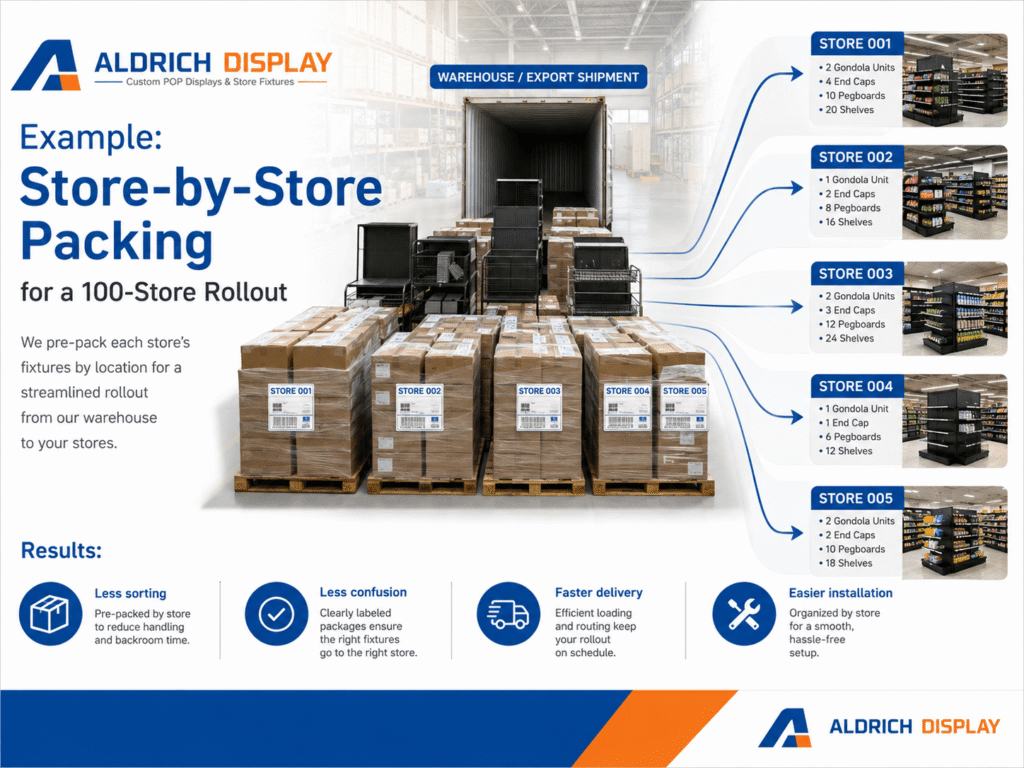
A customer plans a retail display rollout for 100 stores.
Each store needs display racks, shelves, hooks, graphic panels, and installation hardware.
However, the quantities are not the same for every location.
If everything is packed in bulk, the overseas warehouse must sort all items manually after arrival.
This creates extra handling, higher cost, and more chance of mistakes.
With store-by-store packing, the factory prepares each store’s fixture package separately.
For example:
Store 001 – complete display set packed and labeled
Store 002 – different quantity packed separately
Store 003 – special configuration packed individually
Store 004 – accessories matched with the fixture
Store 005 – spare parts included according to requirement
Each carton or pallet is clearly marked with store number, product code, carton number, and quantity.
After the goods arrive overseas, the warehouse can quickly arrange delivery to each store.
The result is:
- Less sorting
- Less confusion
- Faster delivery
- Easier installation
- Better rollout control
This is why packaging is not only a factory detail.
It is part of the whole retail project management process.
What Buyers Should Prepare for Store-by-Store Packing
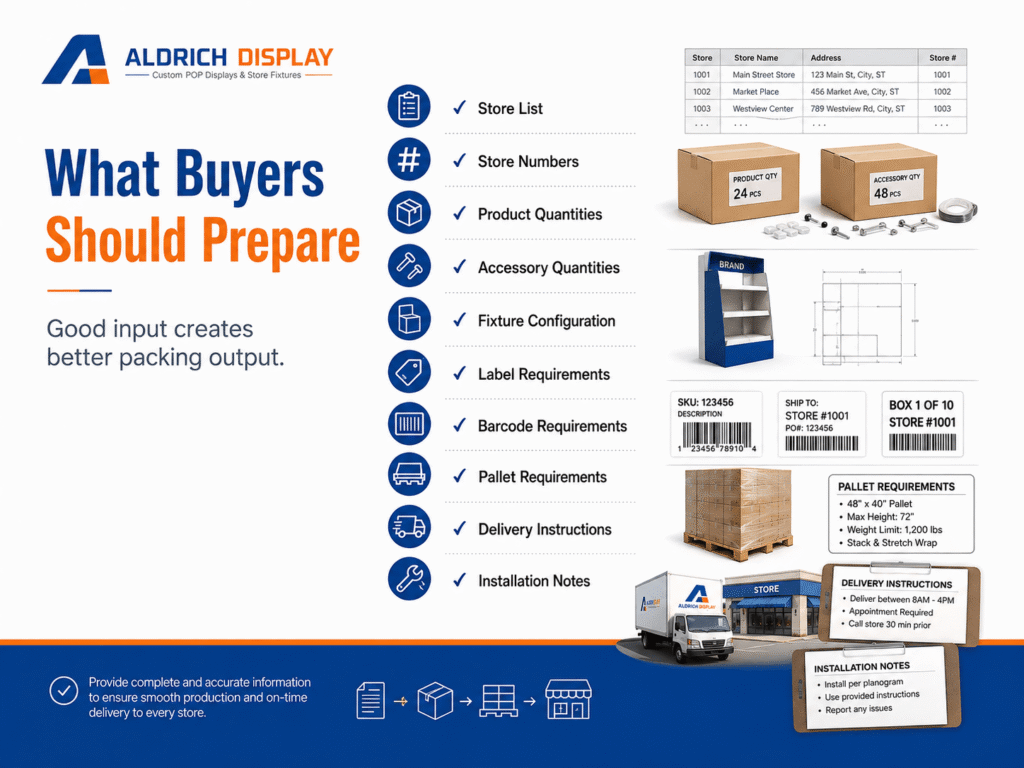
To make store-by-store packing successful, buyers should prepare the information clearly before shipment.
Useful information includes:
- Store list
- Store numbers
- Product quantities by store
- Accessory quantities by store
- Fixture configuration by store
- Label requirements
- Barcode requirements if needed
- Pallet requirements
- Delivery or warehouse instructions
- Installation notes if required
The clearer the information, the easier it is for the manufacturer to prepare accurate packing.
Good input creates better packing output.
Store-by-Store Packaging for POP Displays and Store Fixtures
For custom POP displays, store fixtures, and shopfitting projects, packaging should follow the rollout plan, not only the product structure.
A display may be well made.
But if the packaging does not support the customer’s distribution process, the project may still face delays after arrival.
That is why professional export packaging should consider:
- Product protection
- Carton efficiency
- Pallet stability
- Store distribution
- Accessory matching
- Installation convenience
- Clear identification
This is especially important for chain stores, franchise stores, supermarket programs, brand rollouts, and promotional display campaigns.
FAQ: Store-by-Store Packaging for Retail Rollouts
What is store-by-store packaging?
Store-by-store packaging means packing products according to each individual store’s quantity and configuration requirements, instead of packing all products together in bulk.
Why is store-by-store packing useful for retail rollouts?
It helps reduce warehouse sorting, lower missing parts risk, speed up local delivery, and make store installation easier.
Is store-by-store packing only for large projects?
It is most useful for multi-store projects, especially when the project involves many locations, different quantities, or many accessories.
Can accessories be packed with the main fixture?
Yes. In many cases, accessories, hardware, graphic panels, and installation parts can be matched with the related fixture to reduce installation confusion.
What information should buyers provide?
Buyers should provide a store list, quantity requirements, product configurations, label requirements, pallet instructions, and any special delivery or installation notes.
Does store-by-store packing increase cost?
It may require more planning, labeling, and packing work at the factory side. However, it can often save more cost later by reducing warehouse handling, sorting, repacking, missing parts, and installation delays.
Can store-by-store packing be used for international shipments?
Yes. It is especially useful for international retail projects where goods are manufactured in China and then distributed to many stores overseas.
Final Thoughts
For multi-store retail rollouts, packaging should not be treated as the last step.
It should be part of the project strategy.
A good packing plan connects production, export shipment, warehouse receiving, local delivery, and store installation.
For custom POP displays, store fixtures, and shopfitting programs, store-by-store packaging helps make the whole process more efficient.
The right parts go to the right store.
Less sorting.
Less confusion.
Faster delivery.
Easier installation.
Better rollout control.