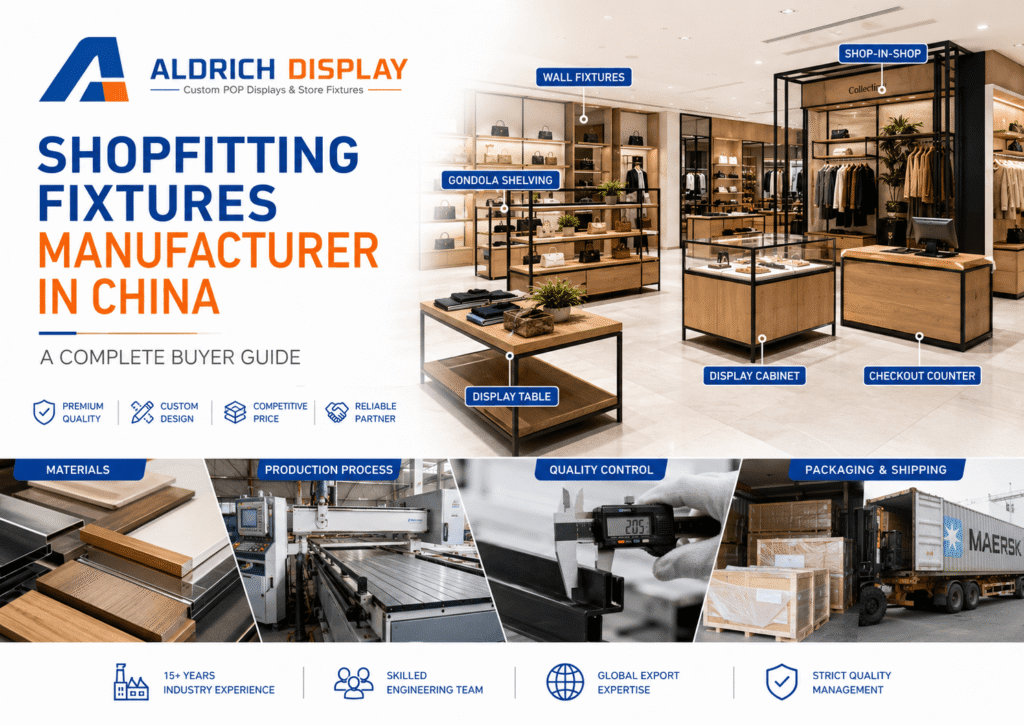
Choosing the right shopfitting fixtures manufacturer in China can make a big difference for retailers, brands, shopfitting contractors, design agencies, and sourcing teams.
Shopfitting fixtures are not just display products.
They are part of the complete retail environment. They help organize products, support brand identity, improve customer flow, create a better shopping experience, and make store operations more efficient.
For many international buyers, China has become an important sourcing destination for custom shopfitting fixtures because of its manufacturing capability, material options, cost efficiency, engineering support, and export experience.
However, sourcing shopfitting fixtures from China also requires careful planning.
Buyers need to understand what type of fixtures are suitable, what materials should be used, how the production process works, how quality is controlled, and how packaging and shipping should be planned.
This complete buyer guide explains what you should know before working with a shopfitting fixtures manufacturer in China.
1. What Are Shopfitting Fixtures?
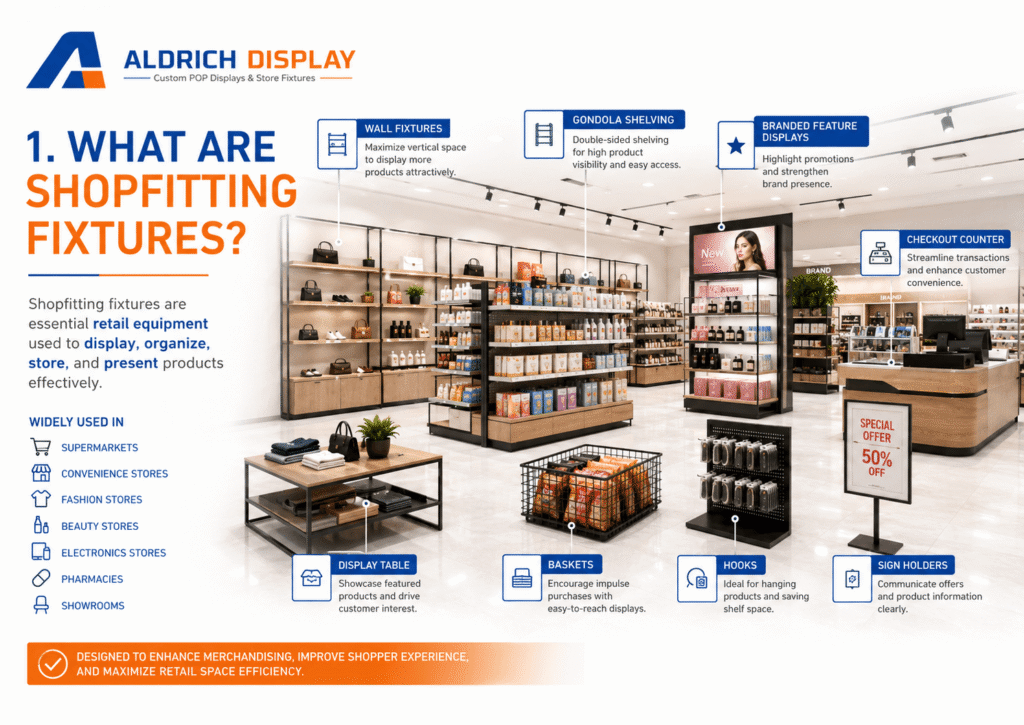
Shopfitting fixtures are custom or standard fixtures used inside retail stores to display, organize, store, and present products.
They are commonly used in:
- Supermarkets
- Convenience stores
- Fashion stores
- Beauty stores
- Electronics stores
- Pharmacies
- Lifestyle stores
- Hardware stores
- Brand showrooms
- Shop-in-shop retail spaces
Shopfitting fixtures may include wall units, gondola shelving, display cabinets, checkout counters, display tables, metal frames, wood shelves, acrylic holders, hooks, baskets, sign holders, and branded feature displays.
Unlike simple display racks, shopfitting fixtures are often connected to the overall store design and retail layout.
They need to match the brand image, support the product category, fit the store space, and perform well during daily retail use.
2. Why Source Shopfitting Fixtures from China?
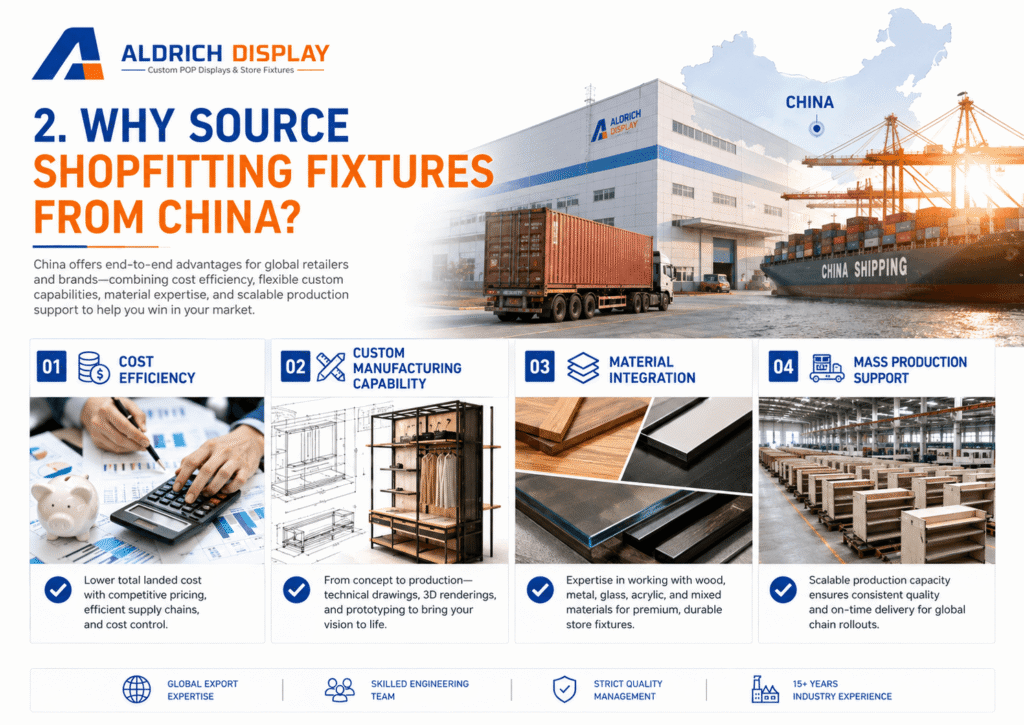
Many buyers choose China manufacturing for shopfitting fixtures because it can offer several advantages.
Cost Efficiency
Local manufacturing can be expensive in many markets, especially for custom metalwork, woodworking, acrylic fabrication, mixed-material fixtures, and batch production.
China production can help reduce manufacturing cost when the project is suitable for overseas sourcing.
However, buyers should not only compare unit price.
A good sourcing decision should also consider packaging, shipping, import costs, installation, and total landed cost.
Custom Manufacturing Capability
Many shopfitting projects are not standard products.
They are made according to drawings, store layouts, brand concepts, or project requirements.
A professional China manufacturer can support custom production based on:
- Technical drawings
- 3D renderings
- Reference images
- Product dimensions
- Store layout plans
- Material requirements
- Branding specifications
This is especially useful for brands and shopfitting contractors that need production support for custom retail projects.
Material Integration
Shopfitting fixtures often use multiple materials.
For example:
- Metal frame + wood shelves
- Wood cabinet + glass doors
- Wire structure + acrylic sign holder
- MDF body + printed graphics
- Powder-coated metal + branded logo panel
A manufacturer with mixed-material capability can help coordinate production more efficiently.
Mass Production Support
For chain store rollouts, consistency is very important.
When the same or similar fixtures need to be produced for many stores, China manufacturing can support repeat production, quality control, packaging planning, and container loading.
3. Common Types of Shopfitting Fixtures
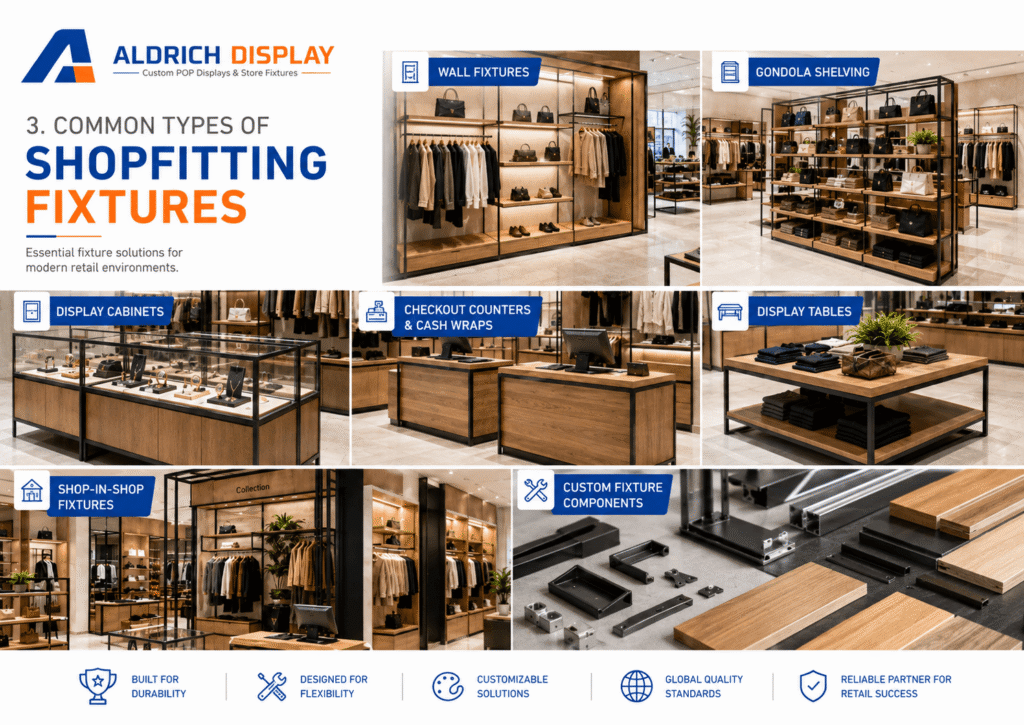
A professional shopfitting fixtures manufacturer in China can usually support many product types.
The right fixture type depends on the store format, product category, and retail purpose.
Wall Fixtures
Wall fixtures are used along store walls to display products while saving floor space.
They may include wall panels, shelves, hooks, cabinets, back panels, and branded display systems.
They are common in fashion stores, supermarkets, pharmacies, beauty stores, and hardware stores.
Gondola Shelving
Gondola shelving is a free-standing fixture system placed in the middle of a store.
It is widely used in supermarkets, convenience stores, pharmacies, and specialty retail stores.
Gondola fixtures can include adjustable shelves, pegboard panels, hooks, baskets, price strips, and signage areas.
Display Cabinets
Display cabinets are suitable for products that need better protection or premium presentation.
They may include glass, acrylic, locks, lighting, wood panels, metal frames, and drawers.
Common applications include cosmetics, eyewear, jewelry, watches, electronics, and accessories.
Checkout Counters and Cash Wraps
Checkout counters are both functional and visual.
A custom checkout counter may include storage space, display shelves, drawers, cable management, logo panels, and customer-facing branding.
It should be durable, practical, and aligned with the store design.
Display Tables
Display tables are often used in fashion, lifestyle, footwear, beauty, and boutique retail environments.
They help create open product presentation and allow customers to interact with products more naturally.
Shop-in-Shop Fixtures
Shop-in-shop fixtures are used when a brand creates a dedicated display area inside a larger retail environment.
They usually require strong branding, clear product layout, and consistent visual identity.
Custom Fixture Components
Some buyers only need specific components instead of complete store fixture systems.
These may include:
- Metal frames
- Wood panels
- Shelves
- Brackets
- Hooks
- Wire baskets
- Acrylic holders
- Graphic panels
- Sign holders
- Hardware kits
This is common for overseas shopfitting contractors who handle installation locally but source fixture components from China.
4. Material Options for Shopfitting Fixtures
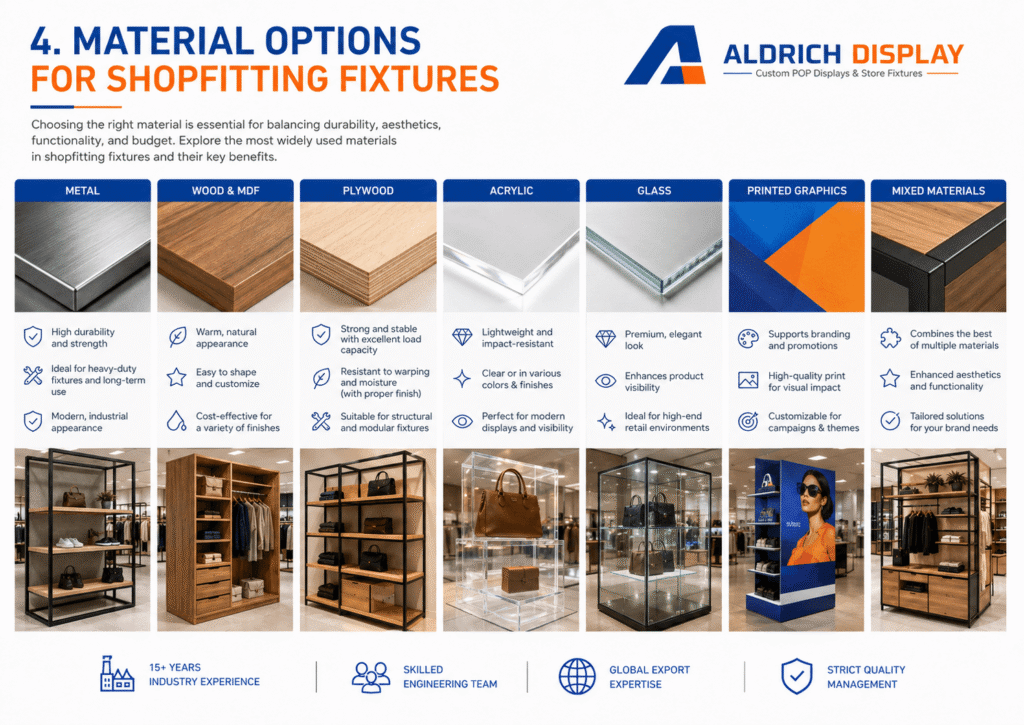
Material selection affects appearance, strength, cost, production method, packaging, and shipping.
A good manufacturer should help buyers choose the right materials based on product needs and store environment.
Metal
Metal is widely used for shopfitting fixtures because it is strong and durable.
It is suitable for frames, shelves, brackets, hooks, support structures, display racks, and heavy-duty fixtures.
Common finishes include powder coating, chrome plating, zinc plating, brushed metal, and other custom finishes.
Wood and MDF
Wood and MDF are popular for retail fixtures that need a warm, premium, or decorative appearance.
They are often used for wall panels, cabinets, display tables, shelves, checkout counters, and branded furniture.
Wood can also be combined with metal frames for better strength.
Plywood
Plywood is often used for stronger cabinet structures, fixture bodies, and shopfitting components.
For some markets or projects, buyers may require specific material standards or certifications.
Acrylic
Acrylic is clean, transparent, and modern.
It is commonly used for product holders, trays, sign holders, covers, countertop displays, and premium presentation details.
Because acrylic can scratch easily, surface protection and careful packing are very important.
Glass
Glass is often used in display cabinets, premium shelving, and high-end retail fixtures.
It creates a clean and professional appearance, but it requires careful design and strong packaging for export shipment.
Printed Graphics
Printed graphics help strengthen brand identity.
They can be used for logo panels, headers, side panels, promotional signs, and product information areas.
Mixed Materials
Many custom shopfitting fixtures use mixed materials.
This can create stronger visual impact and better function.
However, mixed-material projects require good engineering, tolerance control, finishing coordination, and packaging planning.
5. Production Process of Shopfitting Fixtures in China
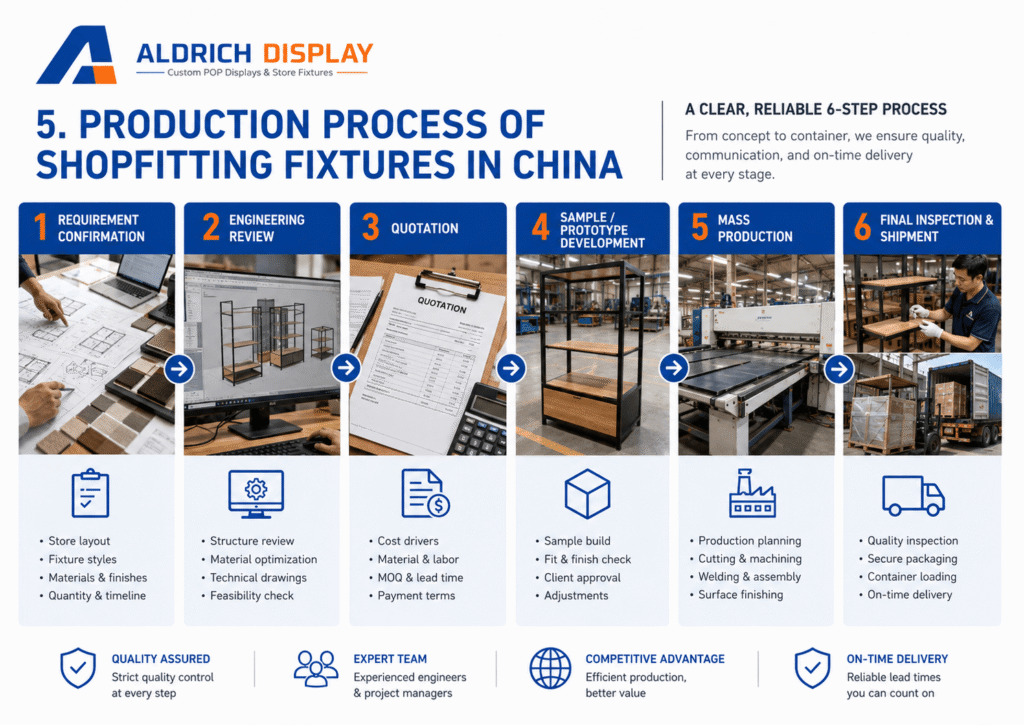
A successful shopfitting fixture project should follow a clear production process.
Step 1: Requirement Confirmation
The first step is understanding the buyer’s project requirements.
Useful information includes:
- Store layout
- Fixture drawings
- Product category
- Fixture dimensions
- Quantity
- Material requirements
- Finish requirements
- Branding details
- Installation method
- Packing requirements
- Destination country
- Target delivery schedule
Clear information helps the manufacturer provide a more accurate quotation and production suggestion.
Step 2: Engineering Review
Before sample development or mass production, the manufacturer should review the structure.
This may include checking:
- Load-bearing strength
- Material thickness
- Connection method
- Assembly logic
- Stability
- Production feasibility
- Packing direction
- Installation requirements
Engineering review helps turn a design concept into a production-ready solution.
Step 3: Quotation
The quotation should be based on confirmed project details.
For custom shopfitting fixtures, the quote should consider material, production process, finish, hardware, printing, packaging, quantity, and export requirements.
A good quotation should not only provide a price.
It should help the buyer understand the production direction and possible cost drivers.
Step 4: Sample or Prototype Development
Sample development is very important for custom shopfitting fixtures.
A sample helps confirm:
- Real size
- Structure
- Material combination
- Surface finish
- Color
- Branding details
- Assembly method
- Product fit
- Packaging direction
If revisions are needed, they should be made before mass production begins.
Step 5: Mass Production
After sample approval and final confirmation, mass production can begin.
Production may include metal cutting, bending, welding, polishing, woodworking, acrylic fabrication, glass preparation, surface treatment, printing, assembly, and packing.
Good production planning helps keep quality consistent and delivery on schedule.
Step 6: Final Inspection and Shipment
Before shipment, the manufacturer should complete final inspection, confirm packaging, prepare labels, organize hardware, support export documents, and arrange container loading.
6. Quality Control for Shopfitting Fixtures
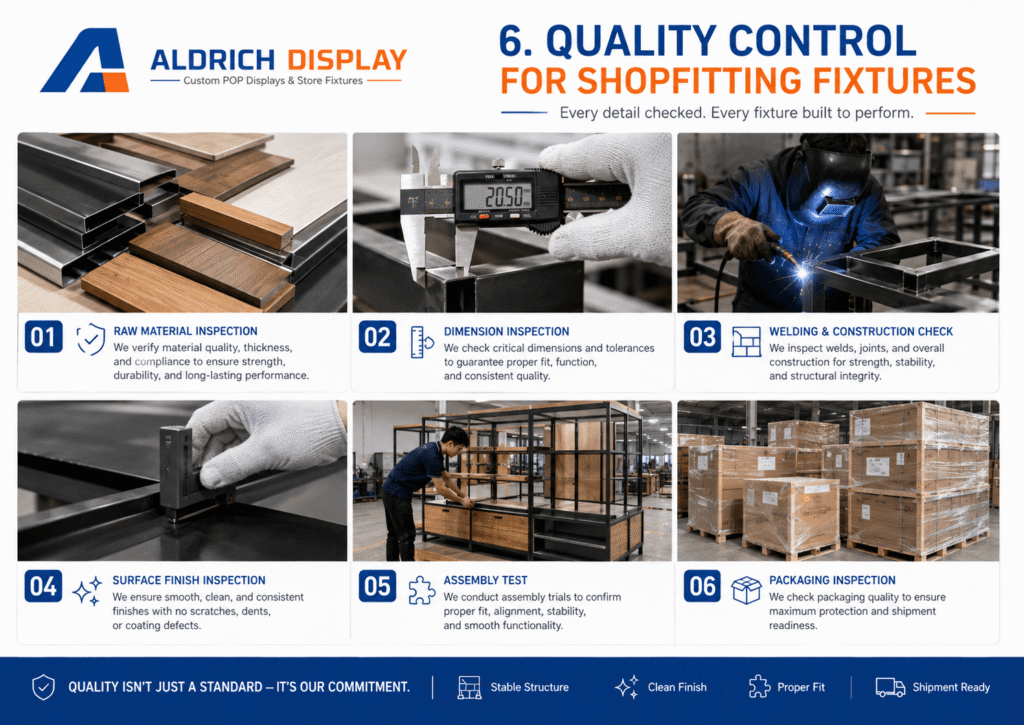
Quality control is one of the most important parts of shopfitting fixture manufacturing.
A good fixture should look professional, assemble smoothly, stay stable, and perform well in retail use.
Raw Material Inspection
The factory should check metal tubes, sheets, wires, MDF, plywood, acrylic, glass, hardware, and printed materials before production starts.
Material thickness, size, color, and surface condition should be confirmed.
Dimension Inspection
Shopfitting fixtures often need to fit specific store spaces.
The factory should check width, height, depth, shelf spacing, panel size, hole positions, bracket locations, and connection points.
Small dimension errors can cause installation problems later.
Welding and Construction Check
For metal fixtures, welding quality should be strong, clean, and consistent.
For wood fixtures, the factory should check joints, edge banding, lamination, cabinet structure, and surface quality.
Surface Finish Inspection
Surface finish affects the final store appearance.
Powder coating should be even and clean.
Wood surfaces should be smooth and consistent.
Acrylic should be free from visible scratches.
Glass should be protected properly.
Printed graphics should match approved artwork.
Assembly Test
For KD or flat-pack fixtures, trial assembly is essential.
The factory should confirm that all parts fit correctly, hardware is complete, holes match, and installation is practical.
Packaging Inspection
Before shipment, packaging should also be checked.
This includes carton strength, inner protection, accessory packing, labels, carton marks, pallet requirements, and loading preparation.
7. Packaging and Shipping for Overseas Projects
For international buyers, packaging and shipping are critical.
A well-made shopfitting fixture still needs strong packaging to arrive safely.
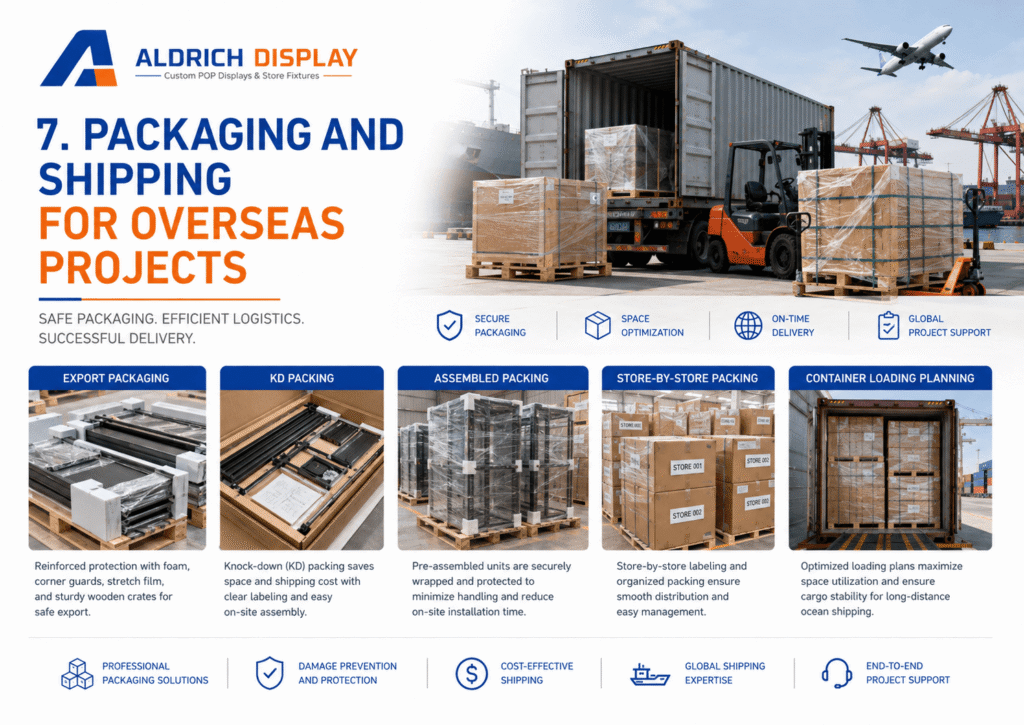
Export Packaging
Different materials need different protection.
For example:
- Metal parts need anti-scratch separation
- Powder-coated surfaces need surface protection
- Wood panels need corner and edge protection
- Acrylic parts need soft wrapping or protective film
- Glass parts need stronger protection
- Hardware needs clear labeling and organization
Good packaging should protect the fixture while controlling carton size and shipping volume.
KD Packing
Many shopfitting fixtures can be designed for KD or flat-pack shipping.
This helps reduce container volume and freight cost.
However, the structure must be tested to make sure assembly is easy, stable, and practical.
Assembled Packing
Some fixtures may need to be shipped fully assembled or semi-assembled.
This can reduce installation work at the destination, but it usually increases shipping volume.
The best method depends on product structure, order quantity, installation plan, and shipping budget.
Store-by-Store Packing
For multi-store retail rollout projects, store-by-store packing can be very useful.
Each store can receive the correct fixtures, accessories, hardware, and installation parts according to the store list.
This reduces warehouse sorting, missing parts risk, and installation confusion.
Container Loading Planning
For large orders, carton size, pallet method, stacking direction, and loading quantity should be reviewed before shipment.
Good loading planning improves shipping efficiency and reduces damage risk.
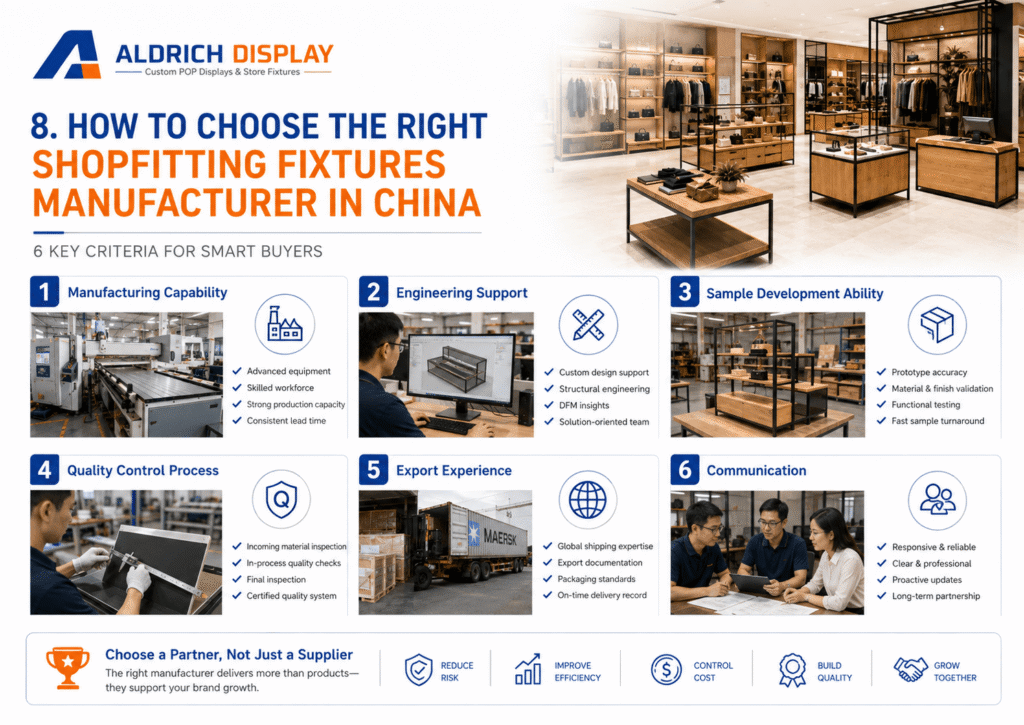
8. How to Choose the Right Shopfitting Fixtures Manufacturer in China
Choosing the right supplier is not only about comparing price.
Buyers should also evaluate the supplier’s capability, experience, process, and communication.
Manufacturing Capability
Check whether the factory can produce the product types and materials your project requires.
For example:
- Metal fixtures
- Wood fixtures
- Acrylic displays
- Glass cabinets
- Wire displays
- Mixed-material shopfitting components
Engineering Support
A professional manufacturer should help review structure, material thickness, assembly method, packaging direction, and production feasibility.
Good engineering support can reduce project risk.
Sample Development Ability
Custom fixtures should usually go through sample or prototype approval before mass production.
A capable manufacturer should be able to develop, review, and improve samples based on buyer feedback.
Quality Control Process
Ask how the supplier controls quality during production.
A good process should include raw material inspection, production inspection, surface finish checking, assembly test, packaging inspection, and final inspection.
Export Experience
For international projects, export experience matters.
The supplier should understand export packing, container loading, shipping documents, carton marks, pallet requirements, and overseas delivery needs.
Communication
Good communication is very important.
A reliable supplier should confirm details clearly, raise potential risks early, and help solve problems instead of simply following instructions without review.
9. Case Example: Custom Shopfitting Fixtures for a Retail Rollout
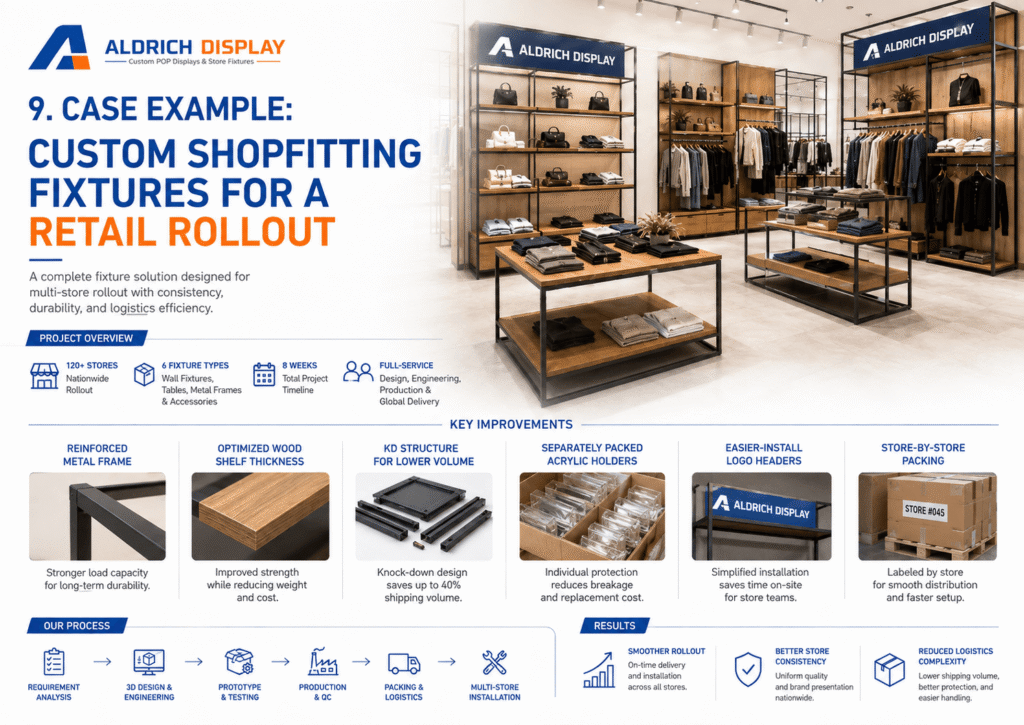
A retail brand planned a rollout for multiple stores.
The project included wall fixtures, display tables, metal frames, wood shelves, logo headers, acrylic holders, and installation hardware.
The buyer wanted the fixtures to look consistent across different stores while keeping production and shipping cost under control.
During engineering review, the manufacturer suggested several improvements.
The metal frame was reinforced for better stability.
The wood shelf thickness was optimized to balance strength and cost.
Some fixtures were changed to KD structure to reduce shipping volume.
The acrylic holders were packed separately to prevent scratches.
The logo headers were designed for easier installation.
Store-by-store packing was used to support local distribution.
After sample approval, the project moved into mass production.
Before shipment, the factory completed trial assembly, dimension inspection, surface finish checking, hardware confirmation, packaging inspection, and container loading planning.
The final fixtures helped the buyer improve store consistency, reduce logistics complexity, and support a smoother retail rollout.
This kind of project shows why buyers should choose a manufacturer that understands not only production, but also engineering, quality control, packaging, and export shipment.
10. FAQ About Shopfitting Fixtures Manufacturing in China
What information is needed for a custom shopfitting fixture quotation?
Useful information includes drawings, store layout, dimensions, material requirements, finish requirements, quantity, branding details, packing requirements, destination country, and delivery schedule.
Can a manufacturer help if we only have a concept or reference image?
Yes. An experienced shopfitting fixtures manufacturer can help turn a concept, sketch, rendering, or reference image into a practical production solution.
What materials are commonly used for shopfitting fixtures?
Common materials include metal, wood, MDF, plywood, acrylic, glass, wire, hardware, and printed graphics. Many projects use mixed materials.
Is sample approval necessary before mass production?
Yes. For custom shopfitting fixtures, sample or prototype approval is strongly recommended. It helps confirm structure, finish, assembly, material combination, and packaging before bulk production.
Can shopfitting fixtures be shipped flat packed?
Yes. Many fixtures can be designed for KD or flat-pack shipping to reduce container volume and freight cost. Trial assembly should be completed before shipment.
How can shipping cost be reduced?
Shipping cost can often be reduced through KD structure, compact carton design, nested parts, efficient hardware packing, pallet planning, and container loading optimization.
What types of shopfitting fixtures can be customized?
Custom products can include wall fixtures, gondola shelving, display cabinets, checkout counters, display tables, shop-in-shop fixtures, metal frames, wood panels, acrylic holders, glass shelves, hooks, baskets, and branded fixture components.
Why source shopfitting fixtures from China?
Many buyers source from China because of cost efficiency, custom manufacturing capability, mixed-material production, engineering support, mass production capacity, and export experience.