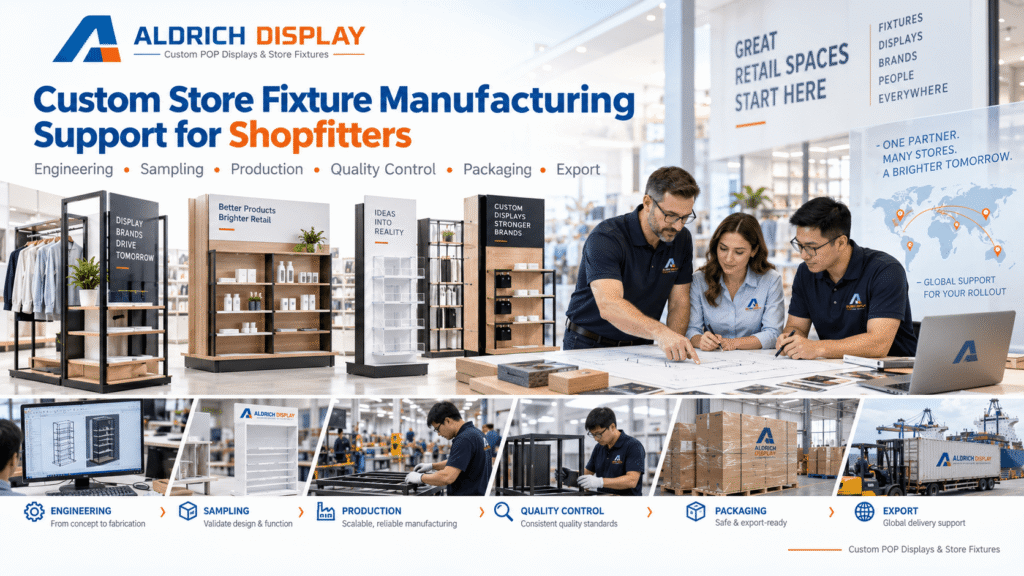
Shopfitting companies are often responsible for much more than installing fixtures.
They may need to manage:
- Client requirements
- Store layouts
- Technical drawings
- Material selection
- Fixture sourcing
- Cost control
- Project schedules
- Installation
- Multi-store rollouts
For many shopfitters, manufacturing every custom fixture locally is not always the most efficient option.
This is especially true when a project involves large quantities, repeatable fixtures, custom metalwork, wood fixtures, acrylic components, or mixed-material retail displays.
That is where a reliable custom store fixture manufacturing partner can provide real value.
Instead of replacing the shopfitter’s role, the manufacturer supports the production side of the project.
The shopfitter remains close to the client, manages the design and local installation, while the manufacturing partner helps turn approved concepts and drawings into production-ready fixtures.
For the right type of project, this model can help shopfitters improve cost control, increase production capacity, and manage larger retail rollout programs more efficiently.
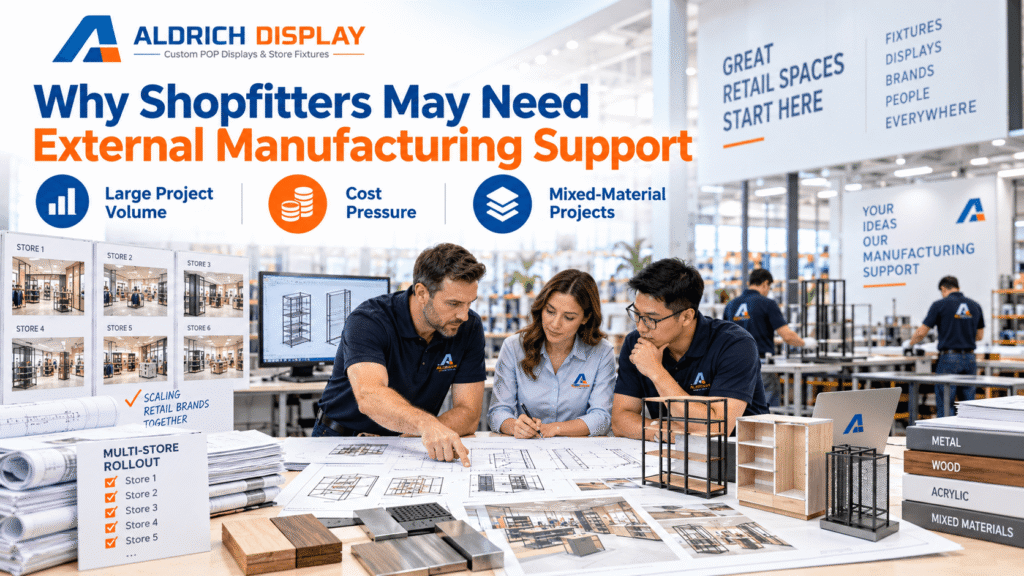
1. Why Shopfitters May Need External Manufacturing Support
A shopfitting contractor may have strong design, project management, and installation capability.
But production capacity can become a challenge when several projects happen at the same time.
Common situations include:
Large Project Volume
A shopfitter may normally handle smaller projects locally.
Then a client suddenly needs fixtures for:
50 stores.
100 stores.
300 stores.
Producing everything internally may create capacity pressure.
An external manufacturing partner can help increase production capacity without requiring the shopfitter to invest in additional machinery, workers, or factory space.
Cost Pressure
Retail clients are often very sensitive to project budgets.
Local production costs can be high, especially for labor-intensive products such as:
- Welded metal fixtures
- Wood cabinets
- Display tables
- Wire racks
- Acrylic components
- Custom shelving
- Mixed-material displays
For suitable projects, sourcing production from China can give shopfitters another manufacturing option when they need to improve competitiveness.
Mixed-Material Projects
Many modern store fixtures are not made from one material.
They may combine:
- Metal
- Wire
- Wood
- MDF
- Plywood
- Acrylic
- Glass
- Printed graphics
- Hardware
Managing several different subcontractors can increase communication complexity.
Working with one manufacturer capable of coordinating multiple production processes can simplify the supply chain.
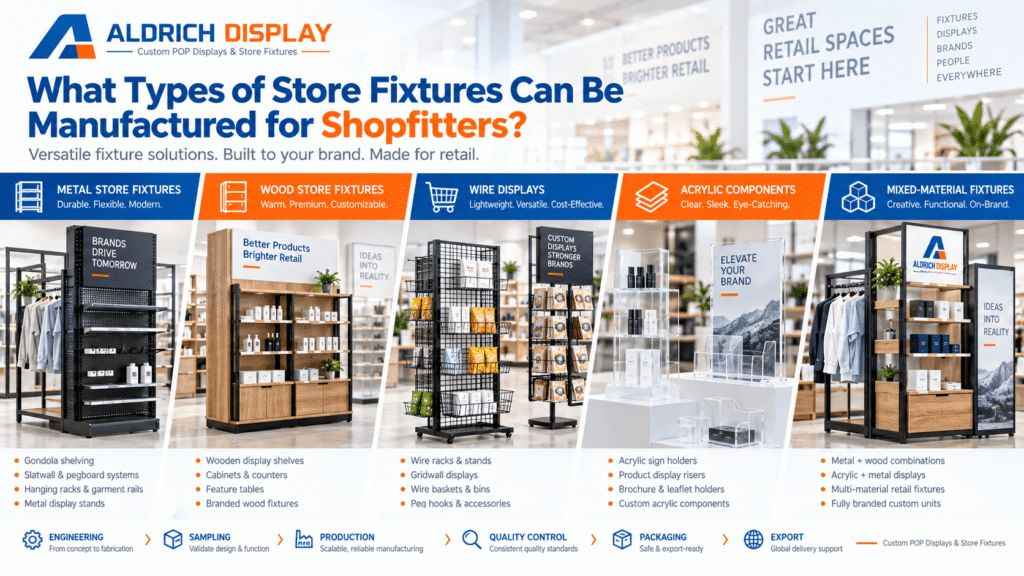
2. What Types of Store Fixtures Can Be Manufactured for Shopfitters?
A custom manufacturing partner can support a wide range of shopfitting products.
Metal Store Fixtures
Metal is widely used because of its strength, durability, and flexibility.
Typical products include:
- Metal display racks
- Wall fixture frames
- Retail shelving
- Gondola components
- Display tables
- Hanging systems
- Brackets
- Hooks
- Metal cabinets
- Structural frames
Surface finishes can include powder coating, chrome plating, zinc plating, and other specified finishes.
Wood Store Fixtures
Wood fixtures are common in premium retail environments.
They may include:
- Display cabinets
- Shelving units
- Counter units
- Cash wraps
- Wall panels
- Display tables
- Branded retail furniture
Wood can be used alone or combined with metal structures.
Wire Displays
Wire displays can be practical and cost-efficient for many retail categories.
Common products include:
- Wire baskets
- Hanging racks
- Dump bins
- Product holders
- Hooks
- Dividers
- Promotional displays
Acrylic Components
Acrylic is commonly used for:
- Product holders
- Sign holders
- Shelves
- Trays
- Branding panels
- Protective covers
It can be integrated into metal or wood fixtures.
Mixed-Material Fixtures
Mixed-material production is especially useful for shopfitters.
For example:
Metal frame + wood shelves + acrylic holders + printed logo panel
This type of project requires coordination between several manufacturing processes.
A capable manufacturing partner can manage those processes together.
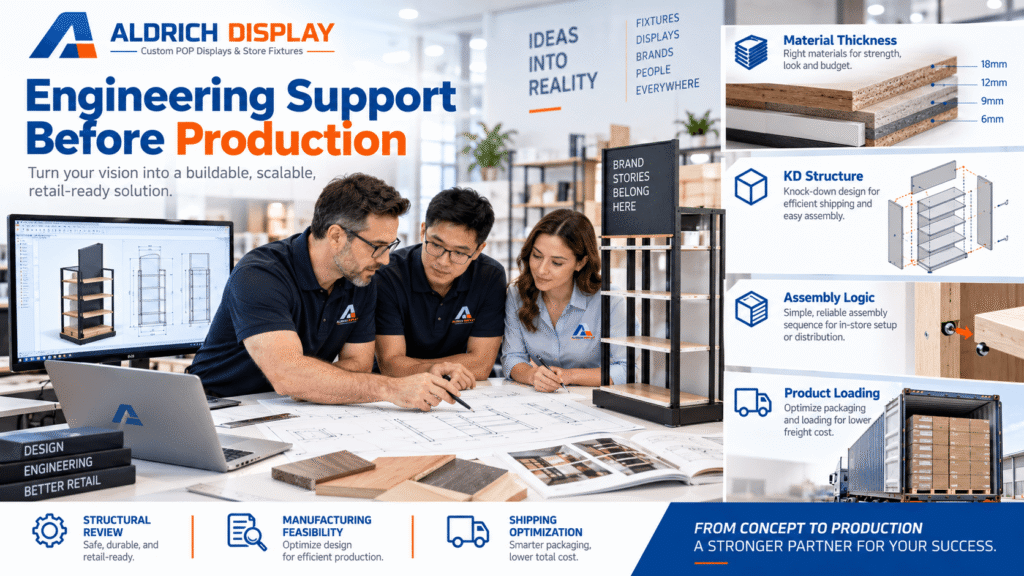
3. Engineering Support Before Production
One of the most important areas of manufacturing support is engineering.
A good factory should not simply receive a drawing and start production.
Before sampling, the structure should be reviewed carefully.
Structural Review
The manufacturer should check:
- Product loading
- Material thickness
- Support points
- Stability
- Connections
- Welding requirements
This helps reduce structural problems later.
Manufacturing Feasibility
Some design details may look good in a rendering but be difficult or expensive to produce.
The engineering team can suggest practical alternatives.
For example:
- Simplifying a welded structure
- Changing a connection
- Adjusting material thickness
- Reducing unnecessary components
- Improving hardware design
The goal is not to change the designer’s concept.
The goal is to make the design easier and more reliable to manufacture.
Shipping Optimization
Engineering should also consider logistics.
A large fully welded fixture may look simple, but it can take a lot of container space.
In some cases, changing the structure to KD can significantly reduce shipping volume.
This can help improve total project cost.
4. Sample Development for Shopfitting Projects
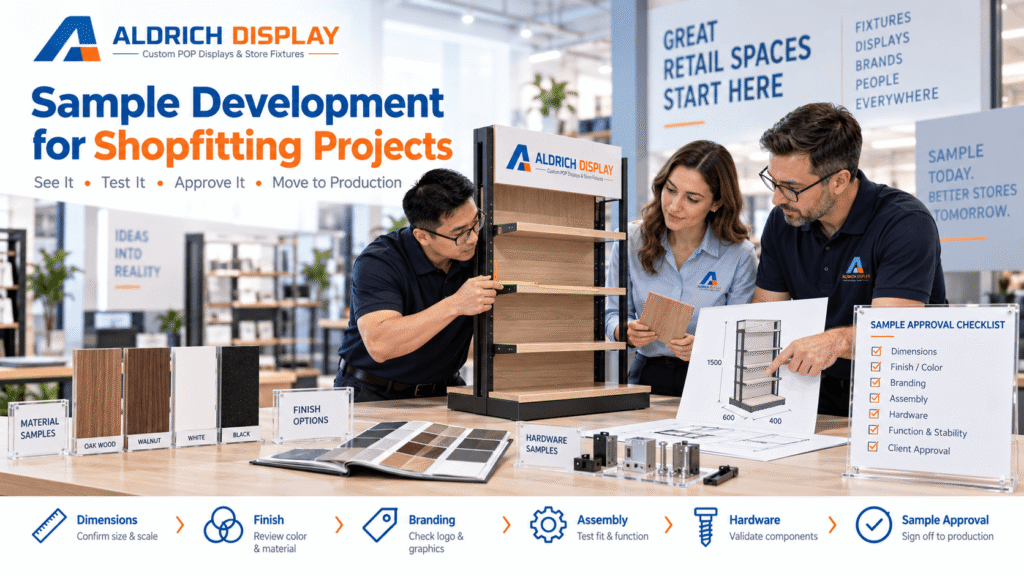
Before mass production, sample development is one of the most useful risk-control steps.
A physical sample allows both the shopfitter and the end client to review the real product.
Important points include:
- Dimensions
- Structure
- Materials
- Color
- Surface finish
- Branding
- Assembly
- Hardware
- Product fit
A drawing may look correct on screen, but a real sample can reveal issues that are difficult to notice digitally.
For example:
A shelf may need more support.
A logo panel may need to move slightly.
A connection may be difficult for installers.
A finish may look different under real lighting.
These adjustments are much easier to make during the sample stage than after mass production begins.
5. Supporting Mass Production for Retail Rollouts
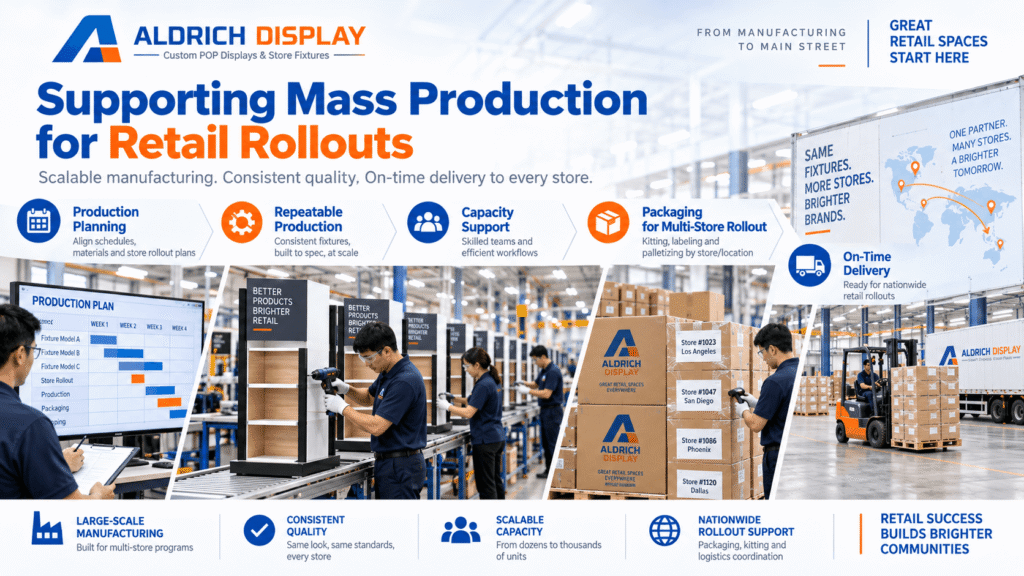
Once the sample is approved, the project can move into mass production.
For shopfitters, this is where manufacturing support becomes especially valuable.
Production Planning
The manufacturer should plan:
- Raw materials
- Tooling
- Production sequence
- Surface finishing
- Assembly
- Packaging
- Shipment schedule
This helps maintain consistency and delivery performance.
Repeatable Production
For multi-store projects, every fixture should follow the same approved standard.
This includes:
- Dimensions
- Color
- Finish
- Hardware
- Branding
- Packaging
Consistent production helps the shopfitter maintain the same store appearance across different locations.
Capacity Support
External manufacturing can also help shopfitters take on larger projects without increasing permanent internal factory capacity.
This can be valuable during peak periods or large retail rollout programs.
6. Quality Control for Custom Store Fixtures
Quality control is critical because shopfitters ultimately need to install the fixtures at the client’s site.
Problems discovered during installation can create expensive delays.
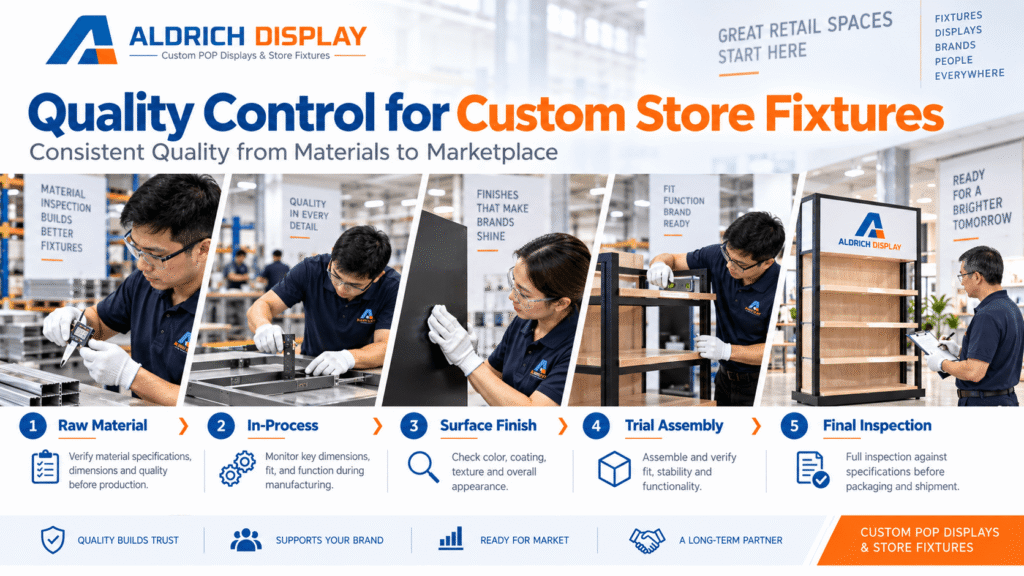
A professional manufacturing process should include several inspection stages.
Raw Material Inspection
Materials should be checked before production begins.
This may include:
- Metal thickness
- Tube sizes
- Wood panels
- Acrylic sheets
- Hardware
- Printed graphics
In-Process Inspection
During production, key points should be checked.
These include:
- Cutting dimensions
- Bending angles
- Welding quality
- Hole positions
- Panel sizes
- Surface preparation
Surface Finish Inspection
Finishes should be checked for:
- Color consistency
- Scratches
- Powder coating defects
- Wood surface quality
- Acrylic damage
- Printing accuracy
Trial Assembly
KD fixtures should be assembled before shipment.
This helps confirm that:
- All components fit
- Holes align
- Hardware is correct
- Installation is practical
Final Inspection
Before packing, the finished products should be checked against approved drawings and samples.
7. Packaging Support for Shopfitting Projects
Packaging is one of the areas where manufacturing experience can save shopfitters a lot of trouble.
A fixture is not finished when production ends.
It still needs to arrive safely and be easy to identify during installation.
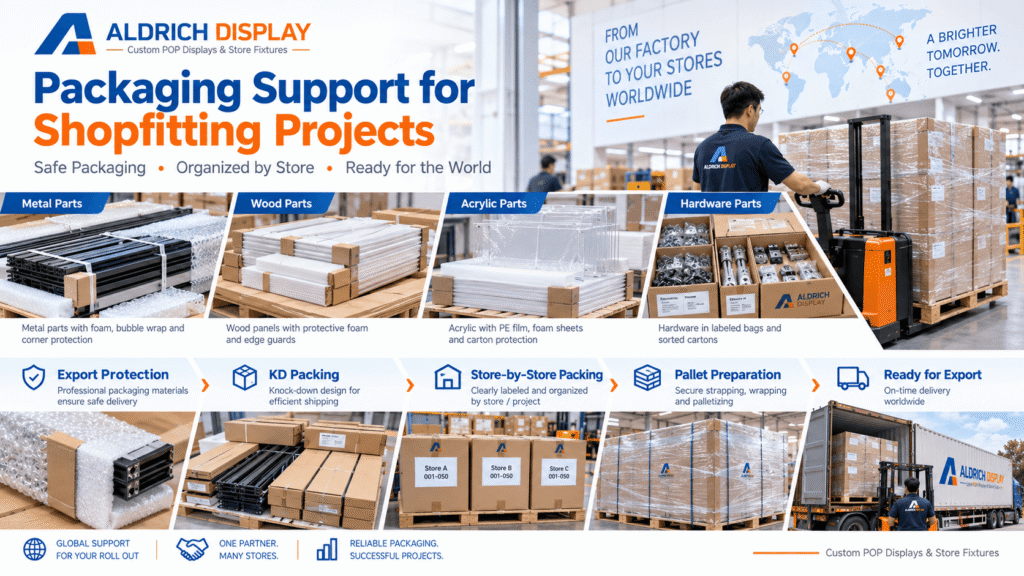
Export Protection
Different materials require different protection.
For example:
Metal surfaces need anti-scratch separation.
Wood panels need corner and edge protection.
Acrylic components need soft wrapping.
Glass requires stronger protection.
Hardware should be organized and labeled.
KD Packing
KD packaging can help reduce shipping volume.
However, it should only be used when the structure remains easy to assemble.
A good KD solution balances:
- Shipping efficiency
- Structural strength
- Installation time
Store-by-Store Packing
For chain store rollouts, products can also be packed according to each store.
Each carton or pallet can include:
- Store number
- Product code
- Quantity
- Part name
- Hardware
- Installation reference
This can help reduce sorting work at the overseas warehouse.
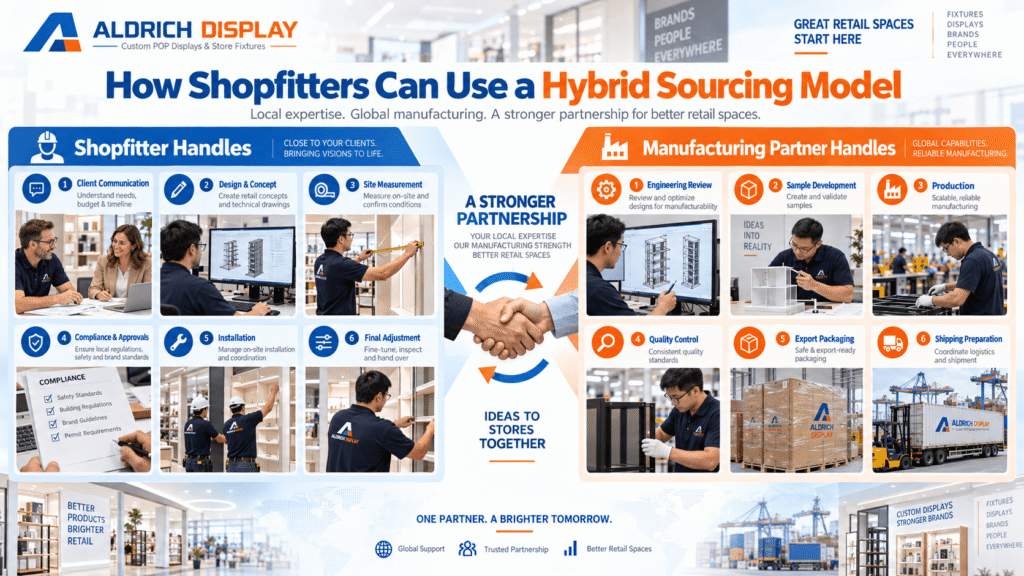
8. How Shopfitters Can Use a Hybrid Sourcing Model
For many projects, the most practical solution is not fully local production or fully overseas execution.
It is a hybrid model.
The Shopfitter Handles:
- Client communication
- Store survey
- Design
- Site measurement
- Local compliance
- Installation
- Final adjustment
The Manufacturing Partner Handles:
- Engineering review
- Sample development
- Fixture manufacturing
- Quality control
- Export packaging
- Shipping preparation
This allows each side to focus on what they do best.
The shopfitter stays close to the client and site.
The manufacturer focuses on efficient production.
For repeatable retail projects, this model can work very well.
9. What Projects Are Best Suited to Overseas Manufacturing Support?
Not every shopfitting project should be manufactured overseas.
The most suitable projects usually have several characteristics.
Clear Drawings
Dimensions, materials, and finishes are already defined.
Repeatable Quantities
The same or similar fixtures are required in larger quantities.
Export-Friendly Structure
The products can be packed and shipped efficiently.
Planned Timeline
The project has enough time for sampling, production, and international shipping.
Cost Sensitivity
The shopfitter needs another production option to improve project competitiveness.
Limited Site Dependency
The fixture can be manufactured before final installation without frequent site changes.
Typical suitable products include:
- POP displays
- Store fixtures
- Retail shelving
- Metal display racks
- Wood cabinets
- Shop-in-shop fixtures
- Branded display furniture
- Retail rollout fixture packages
10. Case Example: Manufacturing Support for a Multi-Store Rollout
A shopfitting company was preparing a retail rollout for multiple locations.
The project included:
- Powder-coated metal frames
- Wood shelving
- Acrylic holders
- Branding panels
- Hooks and accessories
The shopfitter managed the client relationship, store requirements, and installation.
The manufacturing partner supported the production side.
During engineering review, several improvements were identified.
The frame was optimized for stability.
Some connections were changed to make assembly easier.
The fixture was designed in KD form to reduce shipping volume.
Accessories were matched with each fixture set.
Packaging labels were organized according to the store rollout plan.
After sample approval, the project moved into mass production.
Before shipment, the factory completed:
- Dimension checks
- Surface inspection
- Trial assembly
- Hardware verification
- Packaging inspection
- Loading planning
The shopfitter received production-ready fixtures while maintaining control of the client relationship and local installation.
This is a good example of how external manufacturing support can strengthen a shopfitting company without replacing its core role.
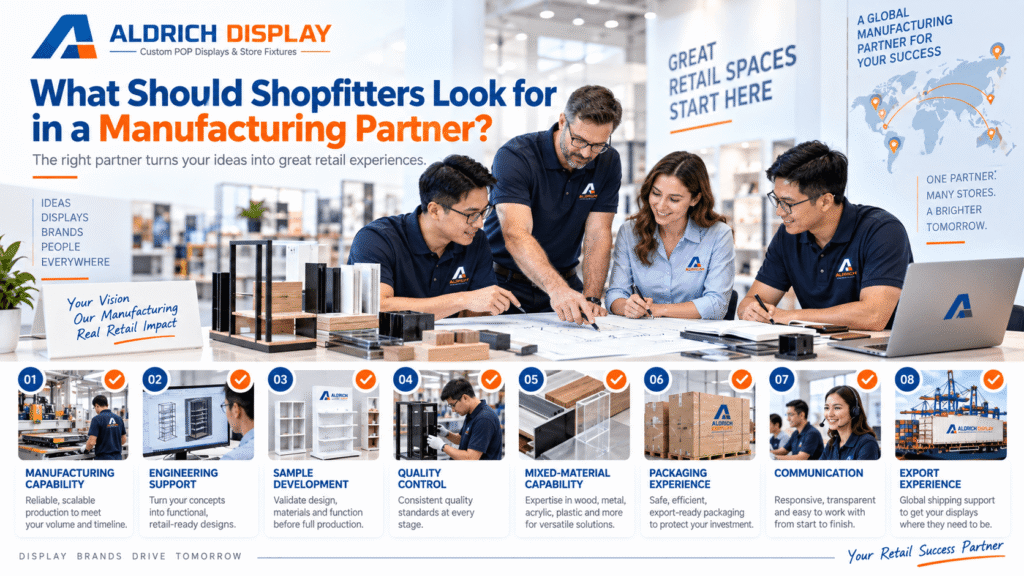
11. What Should Shopfitters Look for in a Manufacturing Partner?
Choosing the right manufacturing partner is important.
Price should not be the only factor.
Shopfitters should evaluate:
Manufacturing Capability
Can the supplier handle the materials and fixture types required?
Engineering Support
Can they review drawings and identify risks before production?
Sample Development
Can they create and revise samples efficiently?
Quality Control
Do they inspect products throughout the production process?
Mixed-Material Capability
Can they coordinate metal, wood, acrylic, wire, and graphics?
Packaging Experience
Can they design export-friendly packing?
Communication
Do they understand technical drawings and project requirements clearly?
Export Experience
Can they support international shipment and documentation?
A good manufacturing partner should help make the shopfitter’s work easier, not create more management work.
12. FAQ About Store Fixture Manufacturing Support for Shopfitters
Can shopfitters outsource only the manufacturing?
Yes. Shopfitters can keep design, client communication, site management, and installation in-house while outsourcing fixture manufacturing.
What information does the factory need?
Useful information includes drawings, dimensions, materials, finishes, quantity, branding details, packaging requirements, and destination country.
Can the manufacturer help optimize drawings?
Yes. An experienced manufacturer can review structure, material thickness, production feasibility, assembly, and packaging.
Can mixed-material fixtures be produced?
Yes. Fixtures can combine metal, wood, wire, acrylic, glass, hardware, and printed graphics.
Is sample development recommended?
Yes. A sample helps confirm structure, finish, assembly, and branding before mass production.
Can fixtures be packed by store?
Yes. Store-by-store packing can help multi-store rollout projects reduce sorting and installation complexity.
Can fixtures be shipped flat packed?
Yes. Many products can be designed in KD form to reduce shipping volume, provided the structure remains practical to assemble.
What types of shopfitting projects are suitable for China manufacturing?
Projects with clear drawings, repeatable quantities, sufficient lead time, export-friendly structures, and cost-control requirements are usually the best fit.
Final Thoughts
For shopfitting companies, a good manufacturing partner should be an extension of the production team.
The goal is not simply to provide cheaper products.
The goal is to help the shopfitter deliver projects more efficiently.
That means supporting:
Engineering → Sampling → Production → Quality Control → Packaging → Export
For repeatable store fixture programs, multi-store rollouts, and custom mixed-material projects, overseas manufacturing can provide valuable additional capacity and cost flexibility.
The shopfitter remains close to the client.
The manufacturer focuses on making the fixtures correctly, consistently, and efficiently.
That is how a strong manufacturing partnership should work.