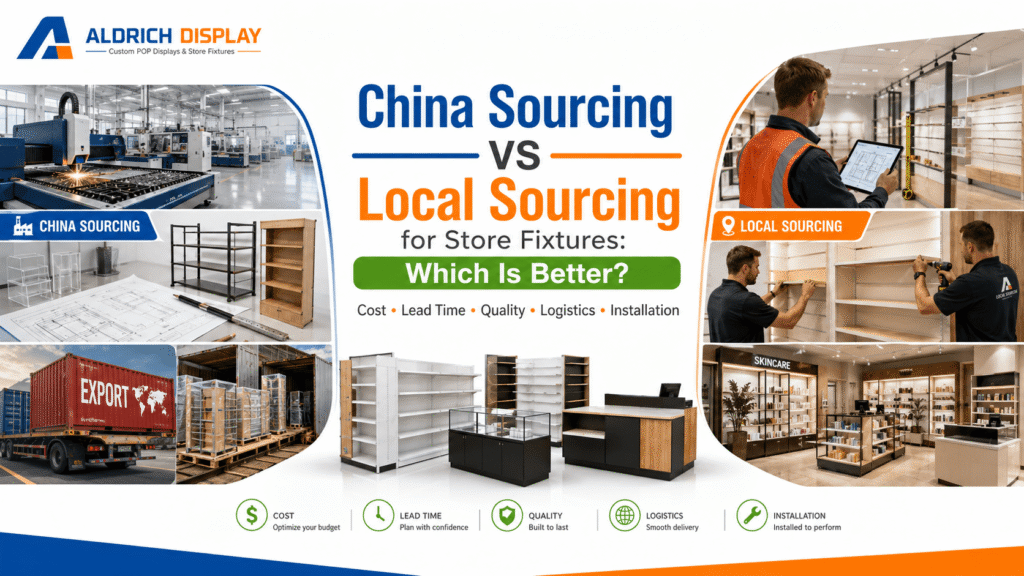
When brands, retailers, shopfitting contractors, and sourcing teams start a new store fixture project, one question often comes up:
Should we source store fixtures from China or manufacture them locally?
There is no single answer that works for every project.
China sourcing can offer strong advantages in manufacturing cost, customization, production scale, and mixed-material capability.
Local sourcing can offer advantages in speed, site coordination, communication, and installation support.
The best choice depends on the type of store fixtures, quantity, project timeline, design complexity, installation requirements, and total project cost.
For many retail projects, the right sourcing strategy is not simply about finding the lowest unit price.
It is about finding the best balance between:
- Cost
- Quality
- Lead time
- Flexibility
- Logistics
- Installation
- Project risk
This guide compares China sourcing vs local sourcing for store fixtures to help buyers decide which model is more suitable for their retail project.
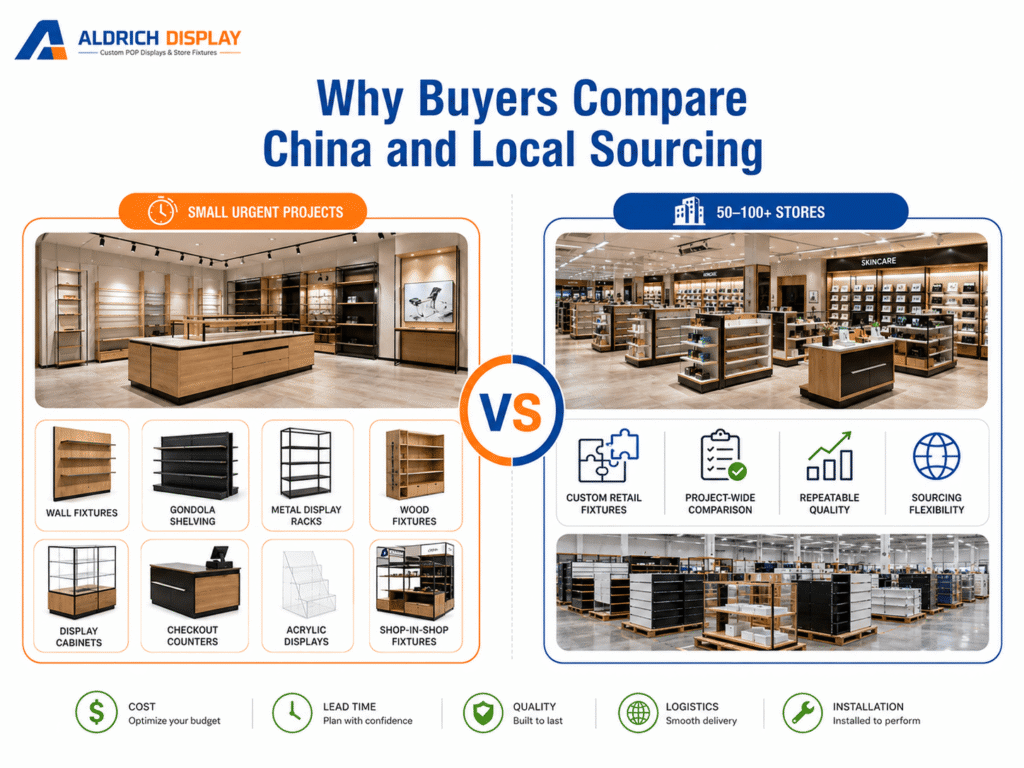
1. Why Buyers Compare China Sourcing and Local Sourcing
Store fixture projects can involve many different products.
These may include:
- Wall fixtures
- Gondola shelving
- Metal display racks
- Wood fixtures
- Display cabinets
- Checkout counters
- Retail display tables
- Acrylic displays
- Shop-in-shop fixtures
- POP displays
- Custom branded fixtures
Some projects involve only a few units.
Others may require fixtures for 50, 100, or several hundred stores.
This difference matters.
A local supplier may be very suitable for a small, urgent, site-specific project.
But for a repeatable multi-store rollout, overseas manufacturing may offer stronger cost and production advantages.
That is why buyers should compare the complete project rather than only the supplier location.
2. Cost: China Sourcing Often Has an Advantage for Larger Projects
Cost is one of the main reasons buyers consider sourcing store fixtures from China.
Custom store fixtures can involve labor-intensive processes such as:
- Metal cutting
- Bending
- Welding
- Grinding and polishing
- Powder coating
- Woodworking
- Acrylic fabrication
- Printing
- Assembly
- Export packaging
For suitable projects, China manufacturing can be more cost-efficient, especially when the order quantity is large enough to benefit from batch production.
Why China sourcing can reduce manufacturing cost
China sourcing may provide advantages through:
- Competitive manufacturing labor
- Large supplier networks
- Efficient raw material sourcing
- Batch production
- Specialized tooling and fixtures
- Integrated metal, wood, acrylic, and printing capabilities
This is especially useful for custom and repeatable store fixture programs.
But factory price is not the full cost
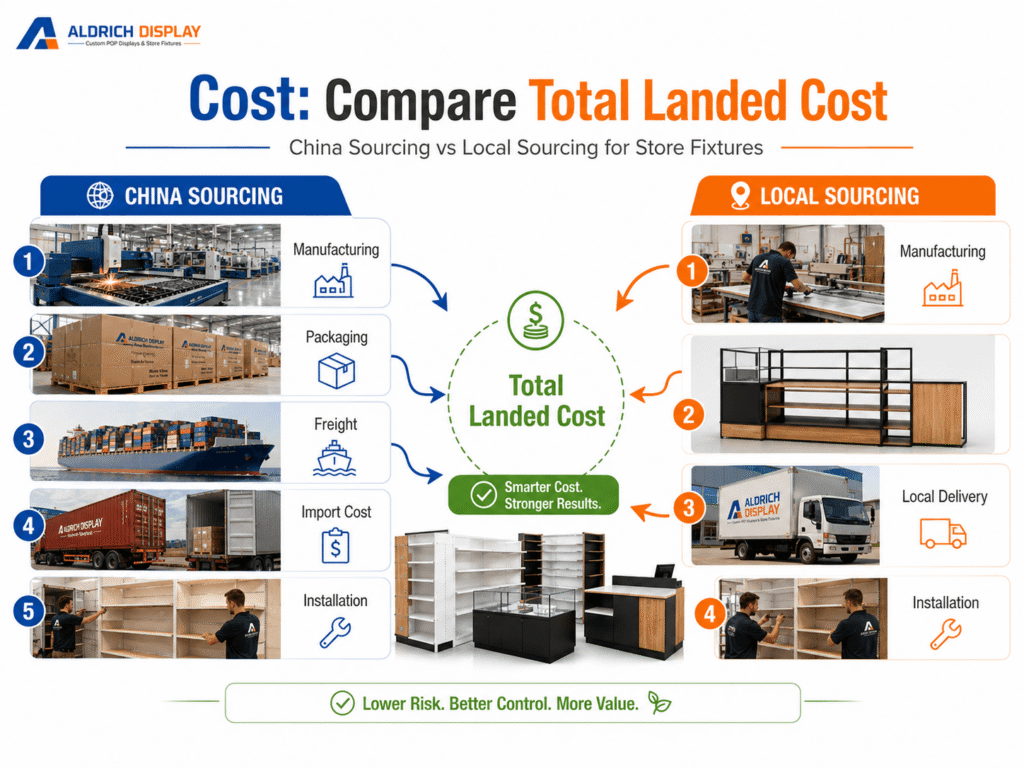
Buyers should not compare only EXW or FOB unit prices.
The real comparison should include:
China sourcing:
Manufacturing + packaging + freight + import cost + local delivery + installation
Local sourcing:
Manufacturing + local transportation + installation
A cheaper factory price does not always mean a cheaper final project.
The correct comparison is total landed cost.
3. Lead Time: Local Sourcing Is Usually Better for Urgent Projects
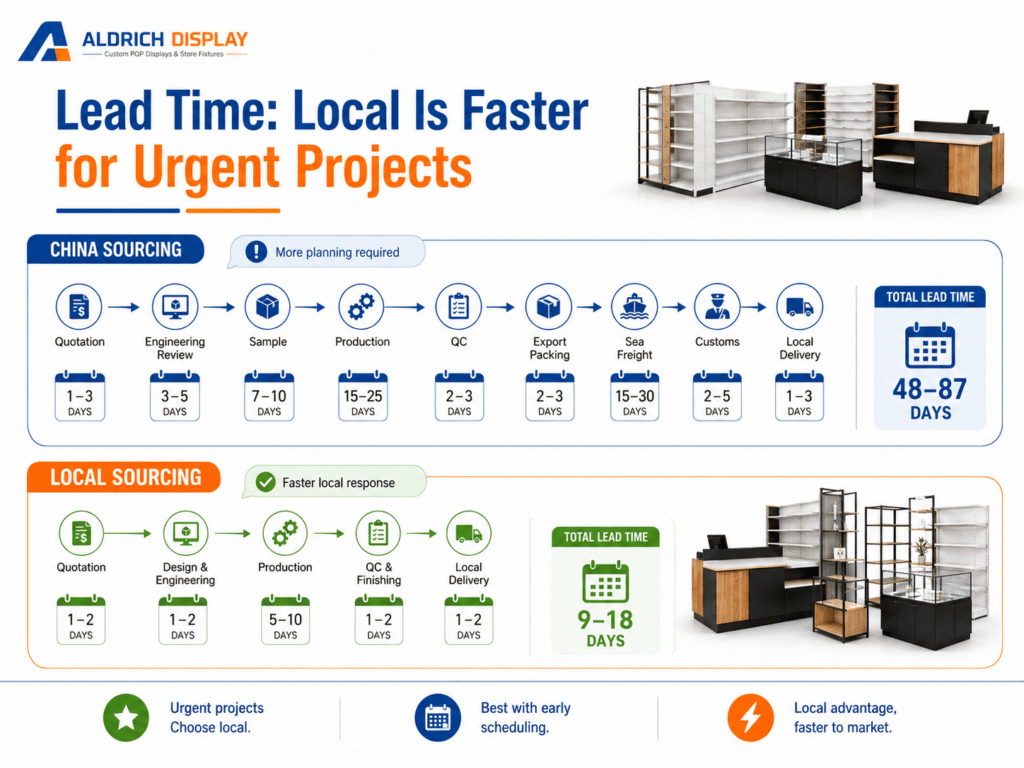
Local manufacturing usually has an advantage when speed is the main priority.
A local supplier does not need to consider long-distance sea freight, import customs, or international logistics.
This makes local sourcing useful for:
- Urgent replacement fixtures
- Last-minute projects
- Small store modifications
- Short promotional campaigns
- Fast pilot-store programs
China sourcing requires more planning.
A typical overseas project may include:
- Quotation
- Engineering review
- Sample development
- Sample approval
- Mass production
- Quality inspection
- Export packing
- Sea freight
- Customs clearance
- Local delivery
This means China production works best when the project timeline is planned early.
For projects with enough preparation time, longer logistics can be managed.
For projects that need delivery in a few days or a few weeks, local sourcing may be more practical.
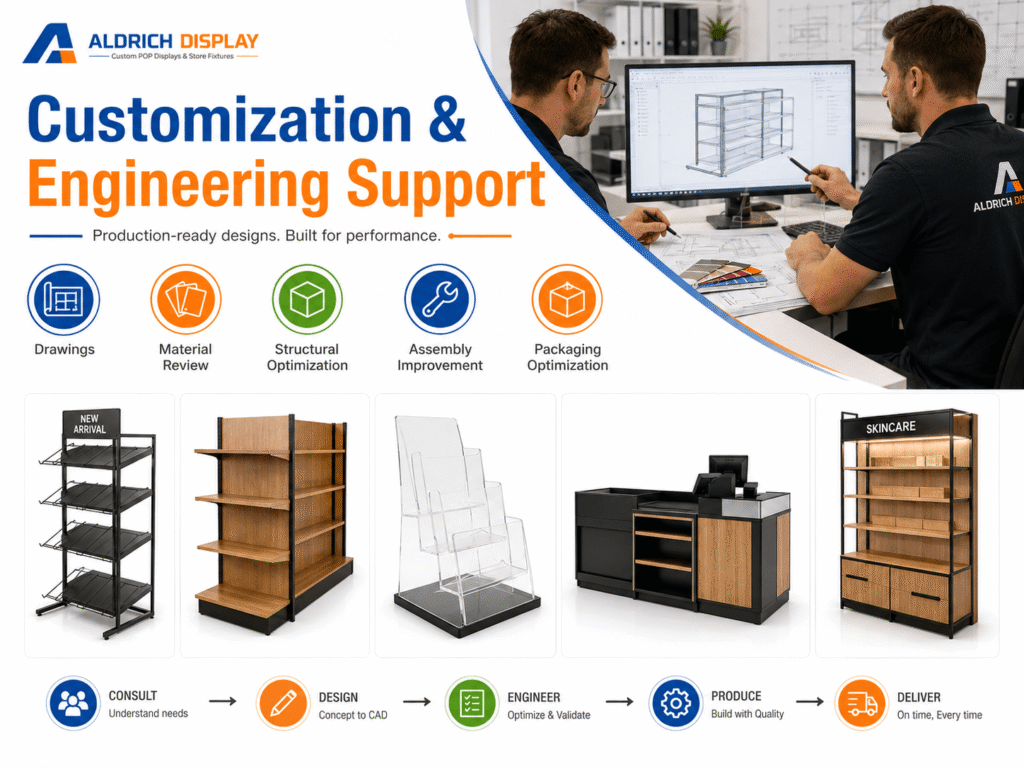
4. Customization: China Can Be Strong for Production-Ready Designs
Custom store fixtures are often made specifically for a brand, product category, or store environment.
China manufacturing can be very effective when the buyer has:
- Clear drawings
- 3D renderings
- Dimensions
- Material requirements
- Surface finish requirements
- Branding specifications
- Quantity
A professional store fixture manufacturer can review the drawings and help turn the design into a production-ready structure.
This may include:
- Structural optimization
- Material thickness review
- Assembly improvement
- Cost reduction suggestions
- Packaging optimization
China sourcing is especially suitable for projects that are already well defined.
Local sourcing can be stronger when the design is still changing frequently or depends heavily on site conditions.
5. Engineering Support: Important for Both Sourcing Models
Good engineering support matters regardless of where the fixture is manufactured.
A store fixture is not only about appearance.
It must also work in the real retail environment.
Important engineering questions include:
- Can the fixture hold the required weight?
- Is the structure stable?
- Can the product be assembled easily?
- Are the materials suitable?
- Can it be packed safely?
- Can it be produced repeatedly?
- Can the design be optimized to reduce cost?
For China sourcing, engineering review is especially important because changes become more difficult after mass production begins.
The best manufacturers do more than follow drawings.
They help identify potential problems before production.
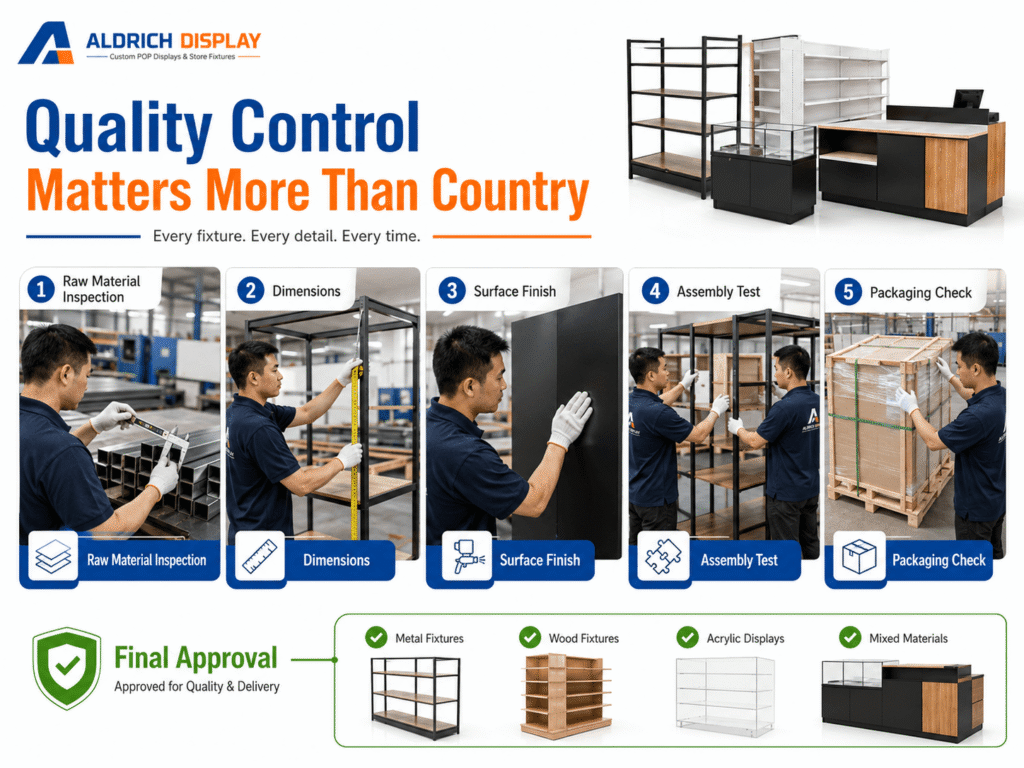
6. Quality Control: The Supplier Process Matters More Than the Country
Some buyers assume local sourcing automatically means better quality.
Others assume China sourcing automatically means lower quality.
Neither assumption is accurate.
Quality depends much more on:
- Supplier capability
- Engineering standards
- Material control
- Production process
- Inspection process
- Sample approval
- Communication
A professional China manufacturer should have quality control throughout the production process.
This can include:
- Raw material inspection
- Dimension checking
- Welding inspection
- Surface finish inspection
- Woodworking inspection
- Acrylic inspection
- Trial assembly
- Packaging inspection
- Final inspection
For custom store fixtures, sample approval before mass production is one of the best ways to reduce risk.
7. Communication and Project Management: Local Sourcing Has a Natural Advantage
Local suppliers often have an advantage in communication.
They may share the same:
- Language
- Time zone
- Business culture
- Local standards
- Installation environment
This can make meetings, site visits, and last-minute discussions easier.
China sourcing requires more structured communication.
Drawings, revisions, finishes, quantities, hardware, packaging, and delivery requirements should all be confirmed clearly.
For this reason, buyers should choose a China supplier with strong project management experience.
Good communication can reduce many of the risks normally associated with overseas sourcing.
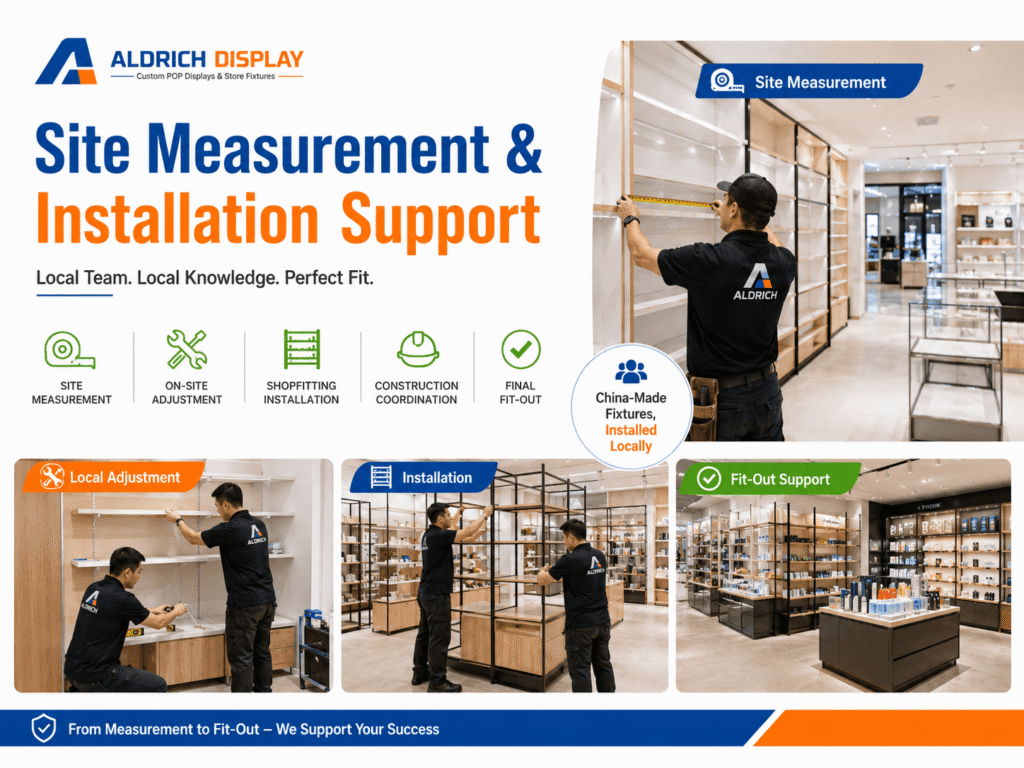
8. Site Measurement and Installation: Local Suppliers Are Often Stronger
One of the biggest differences between China sourcing and local sourcing is site support.
Local shopfitting suppliers can usually provide:
- Site measurement
- Installation
- Local adjustment
- Construction coordination
- Final fit-out work
This is especially important when fixtures depend heavily on actual site conditions.
China manufacturers are usually better suited to producing fixtures that can be manufactured according to confirmed drawings before installation.
For example:
- Metal display racks
- Retail shelving
- Display cabinets
- Wood fixtures
- POP displays
- Shop-in-shop components
- Branded fixture packages
These can be manufactured in China and installed by a local team.
This is why many international projects use a hybrid sourcing model.
9. Shipping and Packaging: A Major Factor in China Sourcing
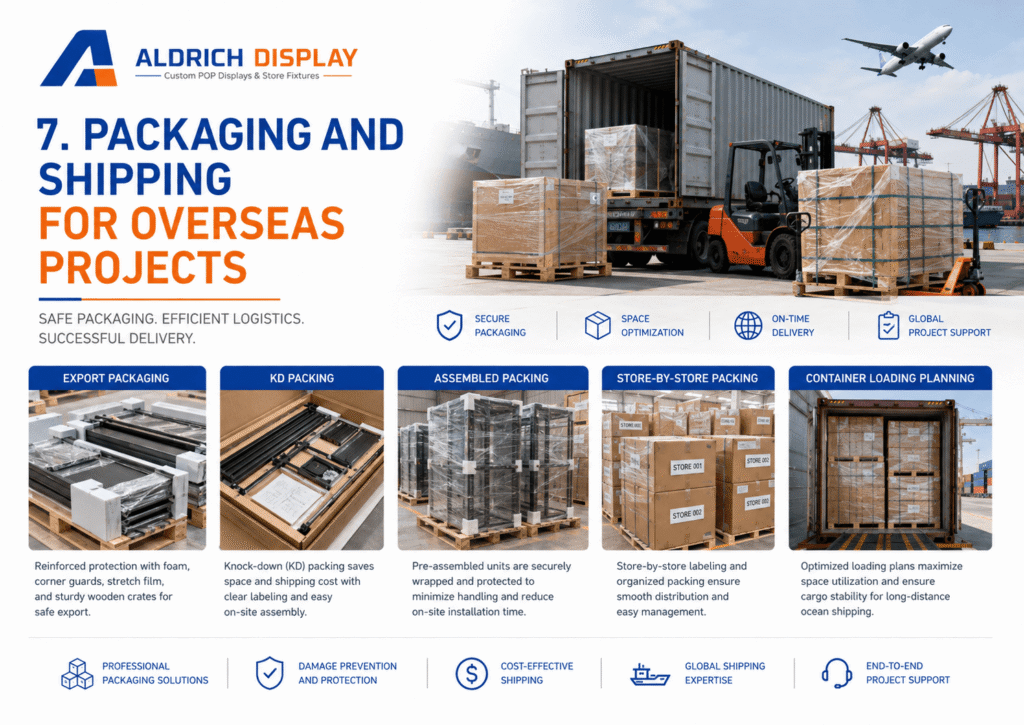
Shipping is one of the biggest areas buyers need to evaluate when sourcing store fixtures from China.
Store fixtures can be large and bulky.
A poor design may create unnecessary freight cost.
This is why packaging should be considered during engineering.
KD vs assembled structure
A fully assembled fixture may be easier to install, but it usually takes more container space.
A KD or flat-pack fixture may reduce shipping volume, but it requires assembly at destination.
The best option depends on:
- Product structure
- Quantity
- Freight cost
- Installation labor
- Customer requirements
Packaging quality
Export packaging also needs to protect:
- Powder-coated metal
- Wood panels
- Acrylic components
- Glass
- Graphics
- Accessories
Good packaging helps reduce scratches, breakage, missing parts, and installation problems.
10. Multi-Store Retail Rollouts: China Sourcing Can Be Very Effective
One of the strongest applications for China manufacturing is the multi-store rollout.
For example:
- 50 stores
- 100 stores
- 300 stores
- Franchise programs
- Chain retail programs
- National promotional campaigns
These projects usually require repeatable fixtures in larger quantities.
China production can help with:
- Batch manufacturing
- Cost control
- Production consistency
- Store-by-store packing
- Container loading planning
- Export coordination
For a large retail rollout, the value is not only the manufacturing price.
It is also the ability to produce many consistent units efficiently.
11. When Is Local Sourcing Better?
Local sourcing may be the better option when:
- Quantity is very small
- Delivery is urgent
- The project changes frequently
- Site measurement is critical
- Heavy installation work is required
- Local construction coordination is necessary
- The fixture cannot be finalized before installation
For example, if a store is still under construction and final dimensions are constantly changing, local production may reduce risk.
Local sourcing is also practical for repair work and urgent replacement fixtures.
12. When Is China Sourcing Better?
China sourcing is often more suitable when the project is:
Repeatable
The same or similar fixture is required in larger quantities.
Drawing-Based
Dimensions, materials, finishes, and structures are already clear.
Cost-Sensitive
The buyer wants to improve manufacturing cost without sacrificing the required quality.
Export-Friendly
The fixtures can be packed, shipped, and installed after arrival.
Mixed-Material
The project combines metal, wood, wire, acrylic, graphics, or other materials.
Planned in Advance
The project timeline allows enough time for sampling, mass production, and international shipment.
Examples include:
- Custom POP displays
- Store fixtures
- Retail displays
- Metal display racks
- Wood fixtures
- Shop-in-shop units
- Display cabinets
- Multi-store rollout fixtures
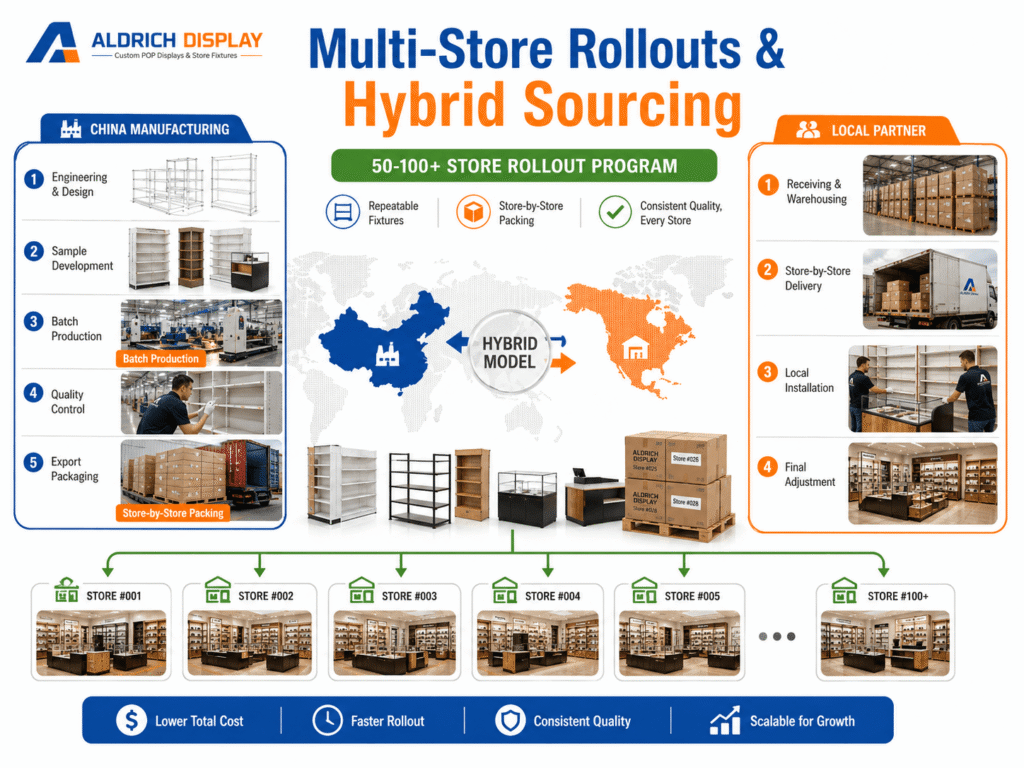
13. Hybrid Sourcing: Often the Best Solution
For many shopfitting projects, the best solution is not 100% China sourcing or 100% local sourcing.
It is a combination of both.
For example:
China supplier:
- Engineering review
- Fixture manufacturing
- Sample development
- Mass production
- Quality control
- Export packaging
Local partner:
- Site measurement
- Warehousing
- Local delivery
- Installation
- Final adjustment
This hybrid model allows buyers to combine the manufacturing advantages of China with the flexibility of local execution.
It is especially effective for large retail rollout projects.
14. Example: China Sourcing for a Multi-Store Fixture Program
A retailer plans to roll out custom store fixtures across 120 locations.
The project includes:
- Metal display racks
- Wood shelves
- Acrylic product holders
- Logo panels
- Hooks and accessories
The design is already approved.
The fixtures are repeatable.
The project has enough lead time.
In this case, China production may be a strong option.
The manufacturer can:
- Review the structure
- Produce a sample
- Optimize the KD design
- Start batch production
- Complete quality control
- Pack fixtures by store
- Prepare container loading
After arrival, the local team can handle delivery and installation.
This sourcing model can help improve manufacturing cost while keeping local execution flexible.
15. China Sourcing vs Local Sourcing: Quick Comparison
| Factor | China Sourcing | Local Sourcing |
|---|---|---|
| Manufacturing Cost | Often more competitive for volume | Often higher |
| Lead Time | Longer | Usually faster |
| Large Quantity | Strong advantage | Depends on capacity |
| Custom Manufacturing | Strong for clear designs | Strong |
| Site Support | Limited | Strong |
| Installation | Usually local partner needed | Easier to coordinate |
| Mixed Materials | Often strong | Depends on supplier |
| Urgent Projects | Less suitable | Strong advantage |
| Multi-Store Rollouts | Very suitable | Can be costly |
| Freight Complexity | Higher | Lower |
| Last-Minute Changes | Difficult | Easier |
16. FAQ About China Sourcing vs Local Sourcing for Store Fixtures
Is it cheaper to manufacture store fixtures in China?
For many larger and repeatable projects, China manufacturing can offer lower production cost. However, buyers should compare total landed cost, including freight, import costs, and local delivery.
What store fixture projects are suitable for China sourcing?
Projects with clear drawings, repeatable quantities, export-friendly structures, sufficient lead time, and cost-control requirements are usually good candidates.
What projects are better for local sourcing?
Urgent, low-volume, site-specific, construction-heavy, or frequently changing projects may be better produced locally.
Is the quality of China-made store fixtures reliable?
Quality depends on the manufacturer, engineering process, material control, sample approval, and inspection system. Buyers should evaluate the supplier rather than judge quality only by country.
Can China manufacturers produce mixed-material store fixtures?
Yes. Many manufacturers can coordinate metal, wire, wood, acrylic, glass, hardware, and printed graphics in one project.
How can shipping costs be reduced?
Shipping costs can often be reduced through KD design, compact packing, nested components, efficient carton sizes, and container loading optimization.
Should buyers always choose the lowest quotation?
No. Buyers should compare material specification, structure, finish, packaging, engineering support, quality control, and total landed cost.
Can local installation be combined with China manufacturing?
Yes. This hybrid model is common and often effective. Fixtures can be manufactured in China while local contractors handle site measurement, delivery, installation, and final adjustment.
Final Thoughts
There is no universal winner in the comparison between China sourcing and local sourcing for store fixtures.
Local sourcing is often stronger for speed, site support, urgent changes, and installation-heavy projects.
China sourcing can offer stronger advantages for repeatable, drawing-based, mixed-material, cost-sensitive, and large-volume fixture programs.
For many international retail projects, the best strategy is a combination:
Manufacture efficiently in China and execute locally where local support is needed.
The best sourcing decision should not be based on unit price alone.
It should consider the complete project:
Design → Engineering → Production → Quality Control → Packaging → Shipping → Installation
If all of these factors are evaluated together, buyers can make a much better sourcing decision.You can send us: